Technological Risks and Fraud
Always alert to protect the bank and its customers
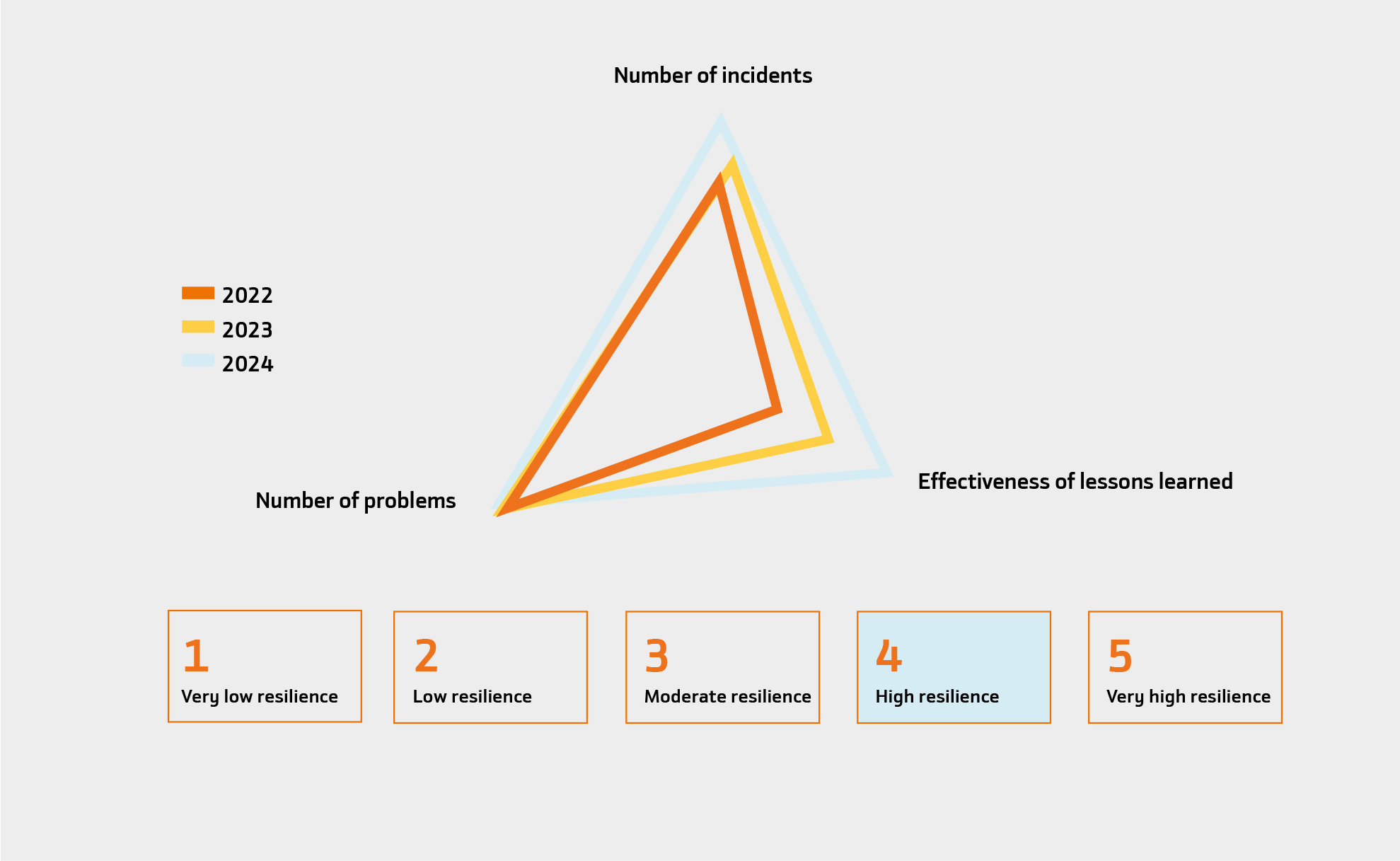
The Technology Risk and Fraud Management Division was created in 2024, with the objective of assessing the bank's technological risks, preparing the business continuity plans and protecting customers through the continuous improvement of tools for preventing and detecting technological fraud.
The current context of uncertainty (armed conflict, increased and more sophisticated cyber attacks, climate change, etc.) requires Bankinter to be constantly updating the catalogue of technological threat and, as a consequence, of the associated risks. These risks are analysed from a two-fold perspective, including outsourcing and internal initiatives that help achieve the Bank's objectives.
In this regard, the main achievements of 2024 were the improvement in ICT risk indicators, the centralisation of the management of major events and incidents, and the development of the ICT Risk Framework, including Bankinter's operational resilience strategy to achieve a high level of resilience, in accordance with the monitoring criteria set forth by the regulation.
The objective for 2025 is to implement the system availability testing plan, so that the lessons learned can drive continuous improvement. Along these lines and also in relation to improving the level of operational resilience, the focus will be on the global vision of suppliers' third-party risk and the improvement in the continuous monitoring of critical technology suppliers.
Fraud
Scammers' methods are constantly changing to deceive their potential victims, which is why an increasingly sophisticated technological ecosystem is required to improve the bank's preventive capacity and response agility.
In 2024, Bankinter defined and launched a new Fraud Risk Management Master Plan, which sets out the strategy and objectives for fraud control for the next two years. The plan focuses on increasing the institution's level of maturity, with the deployment of projects that pursue the development of innovative technological capabilities, efficiency, scalability and global vision, as well as proximity to business and customers.

Improving the experience of potential victims has always been a top priority. In line with this, the Fraud Assistance Service (FAS) was created last year, which operates twenty-four hours a day, seven days a week. It is managed by expert staff who provides a direct line of communication between the customer and the bank for any issues related to possible scams and/or fraud.
In 2025, the challenge remains to put the customer at the centre of the Master Plan, approaching customers' needs from different points of view:
- Optimise the way in which we discriminate between fraudulent and legitimate customer transactions. Reduce the ratios of false positives.
- Automate fraud or scam reporting processes so that affected customers can file a complaint and even receive a refund without having to visit a branch or interact with a real person.
- Help customers address their financial and emotional distress at a time that may undermine their confidence in the bank's ability to protect their money.
- Continue to raise customer awareness, keeping them informed about the most common methods used by scammers and offering advice on how to stay protected.