Sustainability

More resources and a new organisation to respond to new challenges
Over the past decade, Bankinter has demonstrated a strong commitment to sustainability by integrating Environmental, Social and Governance (ESG) criteria into its corporate strategy. The lines of action of this strategy are structured around sustainability plans, such as the Tic-Tac-Toe Plan (2012- 2015 / 2016-2020), the 3D Plan (2021-2023) and the 2024-2026 DNA Plan, which is still in force. These programmes seek to promote sustainable and inclusive development, aligning with corporate values of agility, enthusiasm, integrity and originality. Thanks to these initiatives, Bankinter not only contributes to protecting the environment, but also fosters a positive impact on the society and economy of the countries where it operates. Bankinter's strategy has been recognised in the main ESG indices and rankings.
The bank has been publishing sustainability reports on a regular basis for more than a decade (the so-called non-financial information statements since the entry into force of Law 11/2018 on non-financial information and diversity). In this way, Bankinter guarantees transparency and monitoring of its progress in this area.
In 2024, Bankinter strengthened its Sustainability area, allocating the necessary resources and changing the reporting structure so it would report directly to the Chair's Office. Furthermore, it is under the supervision of the Sustainability and Appointments Committee of the Board of Directors. This Committee is responsible for reviewing the strategic sustainability plan, monitoring the strategy and performance of the Group's ESG indicators, overseeing dialogue with stakeholders, assessing ESG risks and ensuring the public dissemination of non-financial and diversity information.
With this new organisation, Bankinter seeks to respond to the growing challenges in terms of sustainability. Specifically, the new function is aimed at covering the following objectives:
- Promote the identification, evaluation and capture of value creation opportunities arising from the sustainable transition in both the environmental and social dimensions.
- Lead Bankinter to the highest level in the sustainability standards defined by the European Union.
- Ensure complete and rapid adaptation to current and future regulatory and supervisory requirements.
- Transmit Bankinter’s contribution to ESG concerns to its numerous internal and external stakeholders.
A plan with three pillars

In 2023, Bankinter conducted a dual materiality analysis that identified the sustainability priorities relevant to the Bank and its stakeholders. Following this analysis, the Sustainability Policy was updated. These priorities were integrated into the Bank's general principles. Likewise, the Bankinter Group's governance criteria were outlined and the 2024-26 DNA Sustainability Plan was defined.
For the structuring of the plan, the following references, among others, were considered:
- The Spanish Companies Act and Law 11/2018, of 28 December, on non-financial information and diversity.
- Directive (EU) 2022/2464 of the European Parliament and of the Council as regards corporate sustainability reporting (the Corporate Sustainability Reporting Directive or CSRD).
- Delegated Regulation (EU) 2023/2772, supplementing Directive 2013/34/EU of the European Parliament and of the Council as regards sustainability reporting standards.
- The recommendations in the Good Governance Code of Listed Companies approved by the CNMV.
- The commitments that Bankinter has signed within the framework of various internatio - nal initiatives, including, among others, the Guiding Principles of the United Nations Global Compact, the Equator Principles, the Principles for Responsible Banking and the initiative for the Financial Sector of the United Nations Environment Programme and Net-Zero Banking Alliance.
- Analysis of the results of assessments by leading ESG analysts and rating agencies.
- International standards and frameworks related to Sustainability management (GRI, IIRC, ISO 26000, SGE 21, etc.).
- Analysis of the results of satisfaction surveys completed by stakeholder Groups such as customers and employees.
- The challenges of the UN Sustainable Development Goals (SDGs).
- Consideration of the best practices of global sector leaders.
The letter A refers to "Responsible Action". It focuses on the bank's ethical management and its commitment to responsible and transparent business practices. Its strategic lines are corporate governance, ethics and transparency, human rights and supply chain

Action
The strategic pillar 'A', corresponds to "Responsible Action“.
Material issues:
- Corporate Governance
- Ethics and Transparency
- Human Rights
- Supply Chain
The letter D represents the “Differenciation". This includes aspects related to Bankinter's businesses from a perspective of sustainability and also addresses ESG risks. The strategic lines related to this pillar are sustainable finance, climate change, natural capital and cybersecurity.

Differentiation
The strategic pillar 'D', which corresponds to "Differentiation“.
Material issues :
- Customer Relationship
- People Management
- Sustainable Innovation
- Relationship with the Community
And the letter N refers to "Sustainable Business" ("Negocio sostenible" in Spanish) This focuses on the bank's ethical management and its commitment to responsible and transparent business practices. The strategic lines in this area are corporate governance, ethics and transparency, human rights and the supply chain.

Negocio (Business)
The strategic pillar 'N', corresponding to "‘Negocio Sostenible’ (Sustainable Business)“.
Material issues:
- Sustainable Finance/Opportunities
- Climate Change
- Natural Capital
- Cybersecurity
The DNA Plan includes monitoring of initiatives that, given their relevance, are developed in other sections of this report, such as those referring to People, Digital Security and Quality.
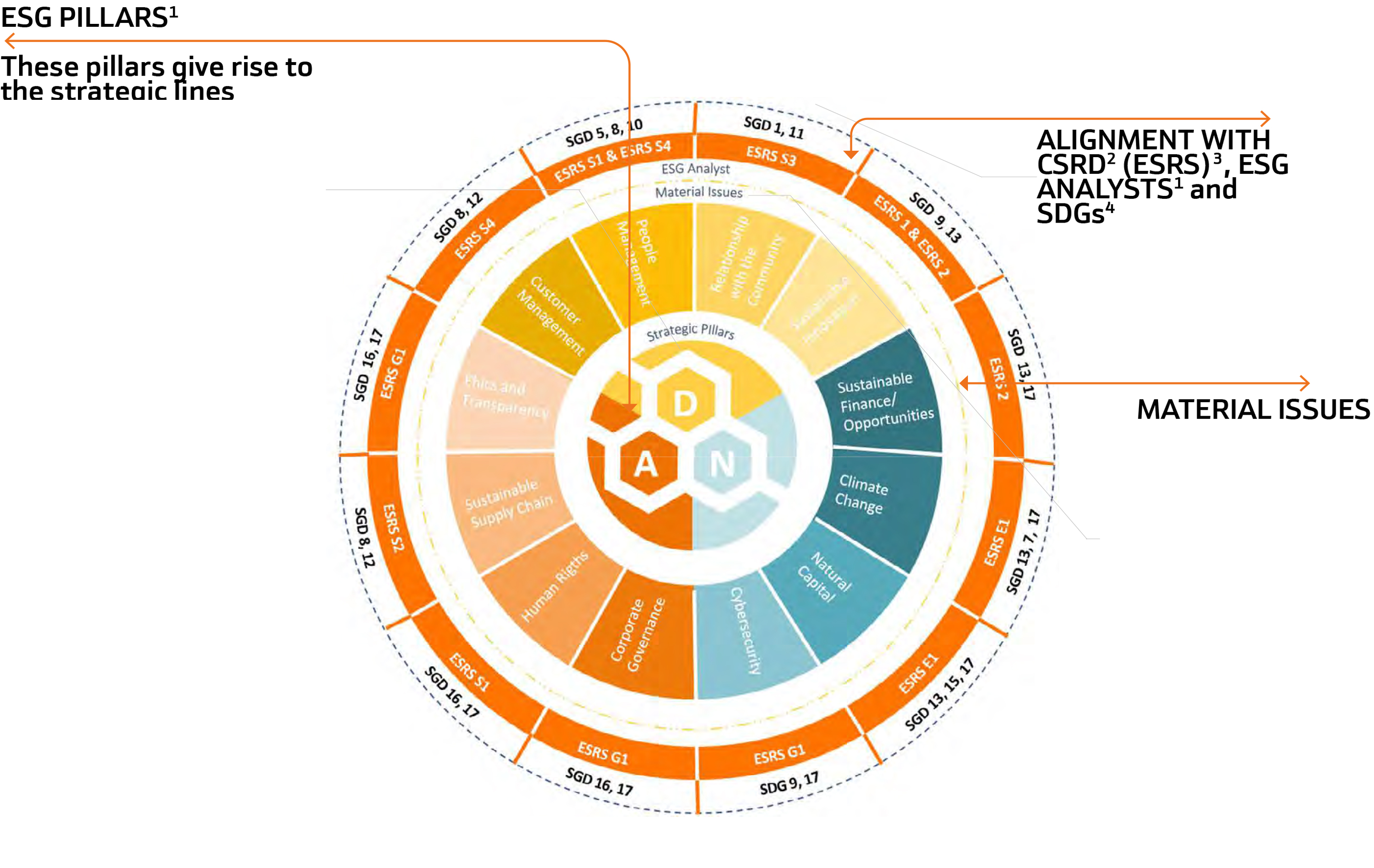
1. ESG: Environmental, Social and Governance
2. CSRD: Corporate Sustainability Reporting Directive
3. ESRS: European Sustainability Reporting Standards
4 SDGs: Sustainable Development Goals
Following the publication of the CSRD, the development of the NEIS (European Sustainability Reporting Standards) and the associated EFRAG (European Financial Reporting Advisory Group) guidelines, Bankinter has updated its materiality analysis. The process of this exercise is detailed in the Non-Financial Information and Sustainability Information Statement and has resulted in the identification of 43 material impacts, risks and opportunities in the areas of governance, climate change, own workers and consumers and end users. According to the new standards, Bankinter aligned the DNA Plan in 2024 with a focus on the initiatives, while homogenising the metrics and structuring all of its control processes.
Make progress in all dimensions
The most relevant milestones achieved during the 2024 financial year are described below.
In the area of Responsible Action, mentioned above, Bankinter reorganised the Group's sustainability governance actions and conducted a new double materiality analysis based on the current sustainability reporting requirements. In addition, Bankinter modified some of the relevant policies within the Group (such as safety, health and well-being), as well as the sector ESG policies within the Risk Framework Agreement.
With regard to Differentiation, Bankinter S.A. and Bankinter Global Services certified their Safety, Health and Wellbeing management system according to the international standard ISO 45001. In addition, the bank continued to promote financial education through different programmes, such as the digital platform "Money Town", the "Your Finances, Your Future" project, together with the AEB, the "Game of Traders" game for students or workshops adapted for seniors and for people with intellectual disabilities.
With regard to third sector support actions, 20% of the bank's workforce in Spain participated in its corporate volunteering programme. Likewise, the bank organised the 13th "Involvement and Solidarity" initiative, which focuses on helping the non-profit organisations proposed by employees and is financed with the funds raised with the Bankinter Solidarios credit card marketed by the bank. Throughout its history, the "Involvement and Solidarity" initiative has helped over 135 social projects, allocating over 667,000 euros.
In the area of Sustainable Business, Bankinter has designed a sustainable finance framework and set up the Sustainable Marking Unit, which aims to assess transactions using sustainability criteria and mitigate the risk of greenwashing. The sustainability axis was also incorporated into the business strategy, in order to systematically identify business initiatives, formalise commercial alliances and develop training plans for the commercial network and its support areas.
In line with commercial developments, Bankinter has also made progress on climate and environmental risk management to meet the requirements of the European Central Bank. In this area, it is worth highlighting that the bank has managed to adhere to the decarbonisation roadmap of the Corporate & SME Banking portfolio, offsetting 5.2% of all emissions per million euros invested when compared to the 2023 figures.
Objectives

Looking ahead to 2025, Bankinter has set the following objectives:
- Complete the implementation of the DNA Plan in all geographies in which the bank operates, also incorporating Avant Money.
- Analyse in more detail the degree of alignment of the business strategy with sector-specific decarbonisation strategies, expand the range of products and solutions for the decarbonisation of customer activities and strengthen the measures to control the risk of greenwashing.
- Strengthen the standardisation of suppliers with ESG criteria and strengthen the due diligence process in terms of human rights, in accordance with the future requirements of the CSDDD (Corporate Sustainability Due Diligence Directive).
- Incorporate accessibility criteria in all its channels of relationship with stakeholders (physical and digital) within the framework of its "A bank for all" programme, taking into account the requirements of the regulations that come into force in July.
A recognised strategy
The work carried out in the field of sustainability, in its three dimensions, was recognised by various national and international organisations:
- Dow Jones Sustainability Index World and Europe, for the seventh year in a row.
- Top Employer.
- Top 3 best companies to work for, according to Actualidad Económica.
- Top 30 in the MERCO ESG ranking.
- One of the most sustainable companies in the world, according to the Time magazine.
- Best Bank in Spain in terms of its CSR performance, according to Euromoney.