Corporate Governance

A transition to a new stage. Stability and ambition
2024 was a pivotal year, marked by the handover of the Non-Executive Chair's Office and the appointment of a new Chief Executive Officer. The process was concluded on 21 March 2024.
A succession process managed in accordance with the provisions of the Succession Policy approved by the Board of Directors has been key to ensuring an orderly transition, thus protecting and also ensuring business continuity without any setbacks, and consolidating a robust and effective governance model to face the challenges of a new stage. As demonstrated throughout the 2024 financial year, this approach has enabled Bankinter to continue to drive a unique and differentiated business model, based on profitable growth, the diversification of sources of income, an omni-channel integration approach, and effective risk control. The bank's model leverages synergies between the Group's subsidiaries and the geographies in which it operates, thereby meeting the expectations of its stakeholders.
A new stage for which the bank has designed an ambitious strategic plan for the creation of long-term value for all our different Groups of stakeholders: Our shareholders, customers, employees and society as a whole.
In addition, in 2024, the Board of Directors asked three new Independent External Directors to join the Board, with a view to strengthening the Bank's position in the face of the challenges posed by the increasingly intense regulations, digitalisation and the risks associated with technological security. The first, appointed by the General Meeting in 2024 and the other two, proposed for appointment by the General Meeting in 2025, which will imply an increase in the number of Board members to 12.
Moreover, and according to the provisions set out in its regulations, the Board of Directors appointed a Lead Director, reinstating a role it had included in the past.
Lastly, in 2024 Bankinter has adopted a new organisational structure in terms of sustainability with the aim of providing and promoting a homogeneous and transversal vision within the Bankinter Group.
Some of the new features and improvements implemented in 2024 are described in greater detail below. More detailed descriptions are provided in the Annual Corporate Governance Report, which is available on Bankinter's corporate website
Composition of the Board of Directors
As stated above, the 2024 Annual General Meeting approved the appointment of Gloria Ortiz Portero as Executive Director of Bankinter and the appointment of a new Independent External Director, Teresa Paz-Ares Rodríguez, both for the statutory term of four years.
Furthermore, the Board of Directors held on the same date appointed María Dolores Dancausa Treviño as Non-Executive Chair of Bankinter and approved the delegation of all powers that by law and according to the bylaws are conferred to Gloria Ortiz Portero, appointing her as CEO. Likewise, it agreed to appoint a Lead Director from among its Independent External Directors, Cristina Garcia-Peri Álvarez, currently the Chair of the Audit Committee.
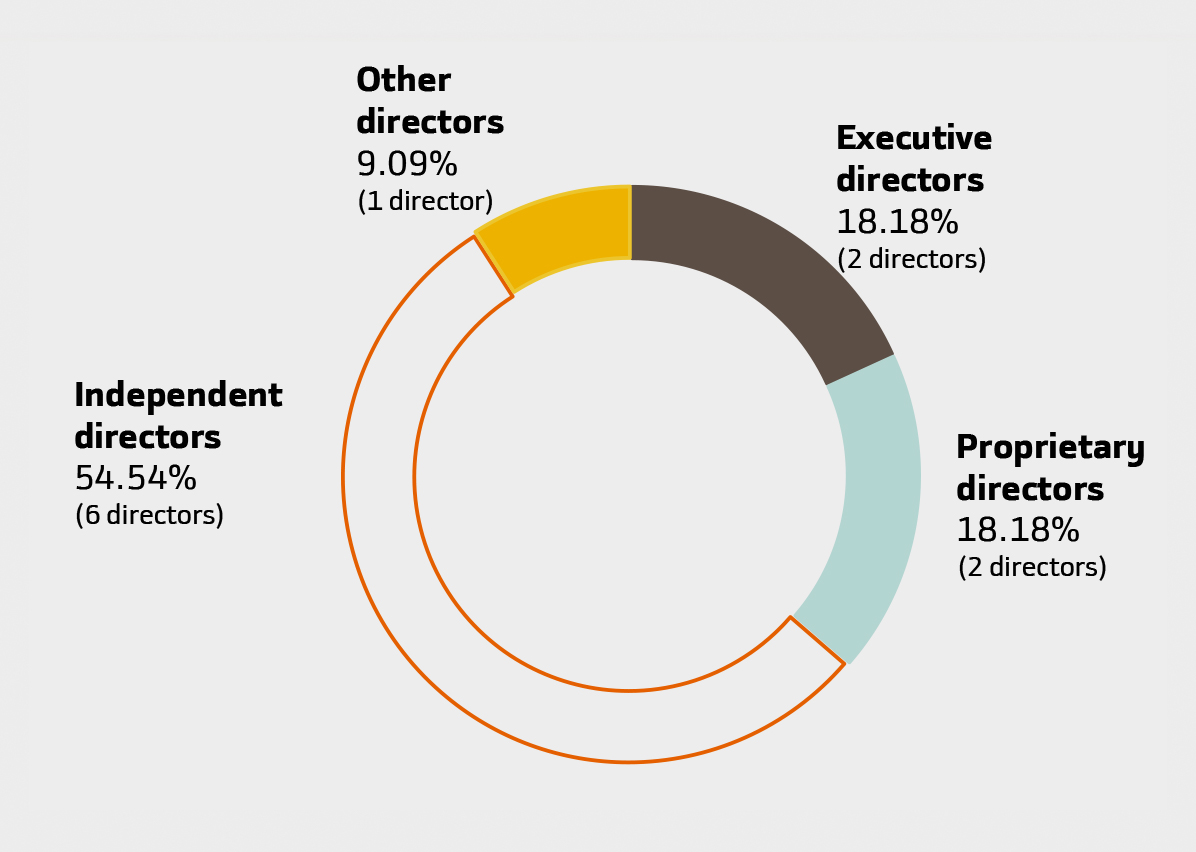
Consequently, the Board of Directors continues to be made up of 11 directors as of the date of issue of this Report, with the following distribution of categories:
Therefore, the Board of Directors maintains the necessary size to foster its effective performance, participation by all Directors and agility in decision-making, as well as a structure that reflects the existing proportion between the company's capital, represented by Proprietary Directors, and the rest of the capital, by having 55% of Independent Directors. In this regard, Bankinter adheres to the national and international best practices and recommendations.
It is also worth noting that the Board of Directors, at the proposal of the Sustainability and Appointments Committee, has agreed to submit to the Annual General Meeting held in March 2025, the appointment of Alfonso Villanueva Rodríguez and Juan Antonio Zufiría Zataraín as Independent External Directors, with a view to strengthening its competencies in the field of technology.
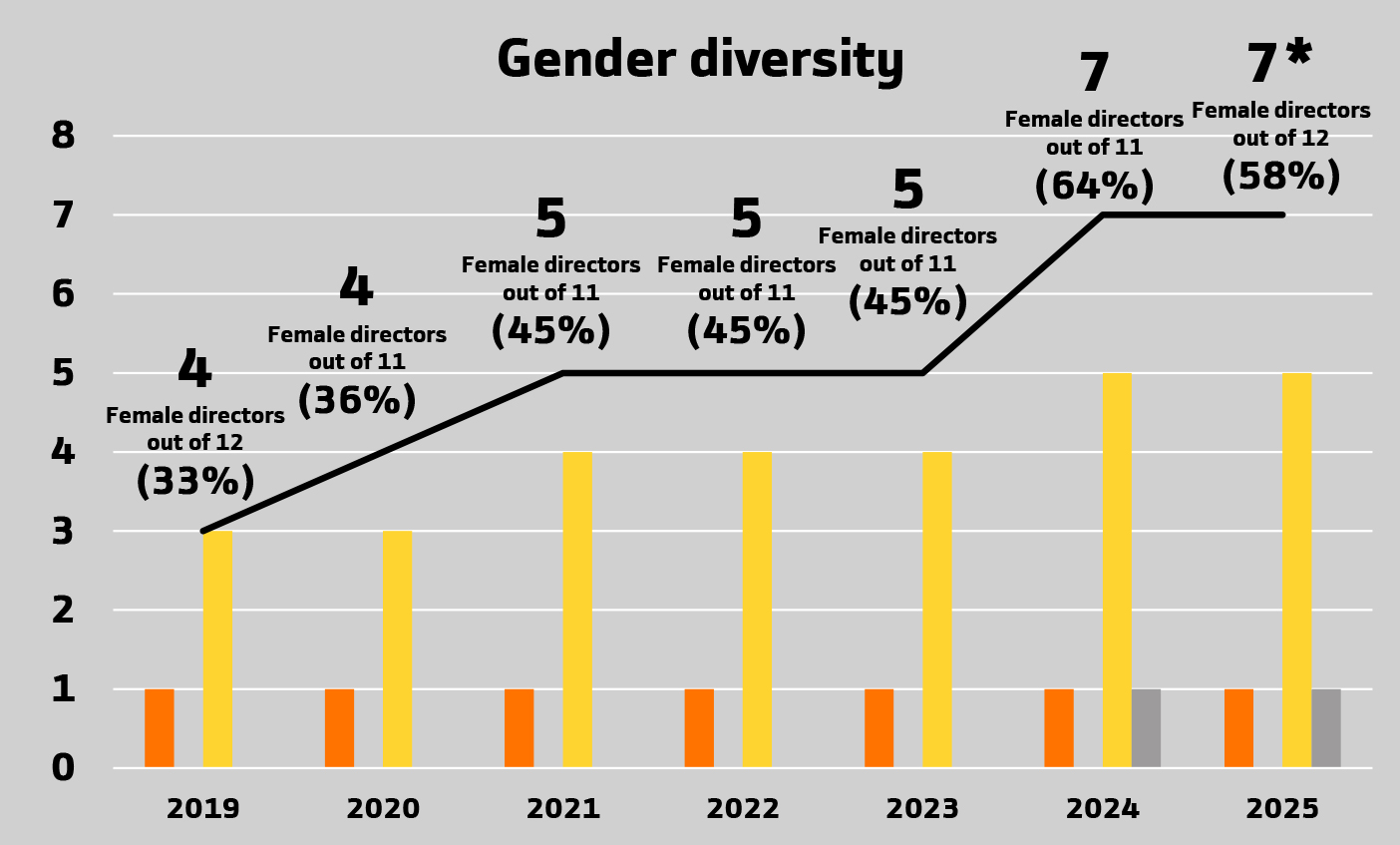
As regards gender diversity, the percentage of women (7) within the Board is above the objectives set by both Bankinter and national and international recommendations and best practices.
In addition, Bankinter is the only company listed in the IBEX35 with two women in the Bank's main administration and management roles (Non-Executive Chair of the Board of Directors and Chief Executive Officer). The other female directors (5) are Independent External Directors.
The progress achieved on the gender diversity objectives is described below:
The Board of Directors as a whole has sufficient and appropriate knowledge, skills and experience to cover all areas necessary to properly understand the development of the bank's activities, including its main risks and to ensure the effective capacity of the Board of Directors to make decisions independently and autonomously for the benefit of the bank:
- The bank's operations and the main related risks, including emerging risks, such as climate, environmental or geopolitical risks.
- Each of the bank's most important activities.
- Relevant areas of sector/financial expertise, including financial and capital markets, capital adequacy and models.
- Accounting and financial reporting.
- Risk management, including emerging risks.
- Compliance and internal audit.
- Information technologies and security.
- Local and regional markets.
- Legal and regulatory environment.
- Leadership skills and management experience.
- Strategic planning capacity.
It is important to note that the collective suitability of the Board of Directors for risk management, in general, given the diversity of the risks, must be objective and related directly to its main activity. However, there are emerging risks, such as climate or geopolitical risks, which are cross-cutting in nature and, without being specific to the bank's activity, can affect multiple aspects of the business. The cross-cutting nature of these risks requires a holistic view and coordinated action by the Board as a whole.
This approach ensures that the Board of Directors' diversity of perspectives and experiences enables its Directors to address the complex and multifaceted challenges posed by emerging or cross-cutting risks effectively, such as those mentioned above.
All in all, the members of Bankinter's Board of Directors have experience in identifying, assessing and managing risks in their areas of responsibility, proof of which can be seen in their annual performance appraisal reports. Likewise, they have the skills and expertise needed to understand how all types of risks can impact the Bank's operations, its customers and the market on a global scale. Therefore, Directors are also in a position to understand and monitor emerging risks.
In addition, on-going training and specialised external advice, when deemed necessary, are elements that ensure this understanding and supervisory capacity through the updating of the Board Members' knowledge and experiences regarding the latest trends, regulations and supervisory expectations, and best practices in risk management. This guarantees that the Board ensures these risks are integrated into the business strategy at all times, which includes incorporating them into decision-making processes, remuneration and long-term planning.
For more details on the expertise of the Members of Bankinter's Board of Directors, please refer to the Annual Corporate Governance Report, which is available on the Bankinter corporate website.
Board Committees
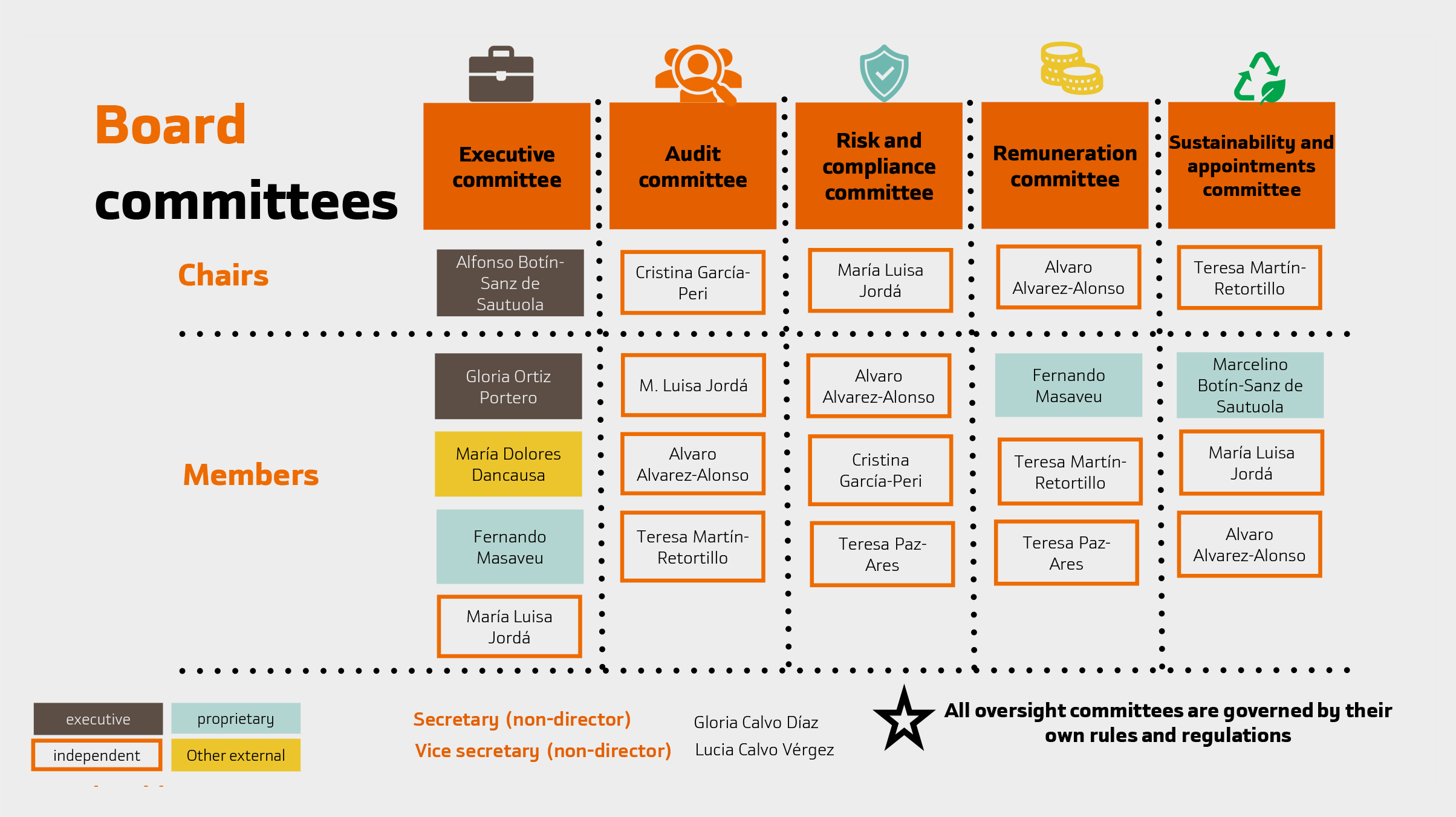
In 2024, changes have occurred in the composition of Bankinter's Board Committees as a result of changes within the Board. The composition as of 31 December 2024 is as follows.
In addition, in January 2025 and at the proposal of the Sustainability and Appointments Committee, the Board of Directors approved the incorporation of María Teresa Pulido Mendoza as the Director of the Executive Committee and of the Sustainability and Appointments Committee. Thanks to her extensive experience as Director of Strategy in a multinational transport and mobility infrastructure company, with important implications in terms of sustainability in general and, specifically, in environmental matters, as well thanks to her in-depth understanding of how Bankinter and its Group works, this will boost the expertise of both Committees in their respective areas of responsibility.
General Shareholders Meeting
Since 2021, Bankinter has had the necessary statutory authorisation to hold meetings exclusively by electronic means, with all the necessary provisions to ensure that shareholders can attend and effectively exercise all their rights. Having this possibility gives the Bank greater flexibility, which can be very useful in situations where this format is advisable without relying on exceptional legislative measures.
Bankinter has a communication policy with shareholders, institutional investors and proxy advisors aimed at taking their legitimate interests into account. Therefore, they receive information on the bank's priorities and criteria in relation to all matters related to corporate governance, among other aspects of management. Dialogue with stakeholders continues to be one of Bankinter's priorities, through which it verifies that its strategy and objectives are in line with their expectations, and ensures the continuity of those who drive its profitability and sustainable growth. Bankinter provides information on the bank's priorities and criteria in relation to all matters related to corporate governance, among other aspects of management.
Coherent structure
One of the pillars of Bankinter's robust Corporate Governance system is its internal rules and regulations, comprising the frameworks, policies and procedures governing the different areas of its corporate life and activity, in accordance with the applicable external regulations and best practices. The consolidation of these into a coherent regulatory pyramid, included in the Group's Corporate Governance Policy, which has been reviewed and updated in 2024. This ensures that the internal rules and regulations maintain, at all times, an efficient structure, with clear and well-defined areas of application and powers of proposal, approval and monitoring, with the aim of facilitating the supervisory function of the Board and other governing bodies.
As regards the Bankinter Group's structure, relations with subsidiaries are based on a solid mechanism for coordinating their internal governance systems. In accordance with the Corporate Governance Policy, the Board of Directors establishes the appropriate guidelines to ensure the exchange of information necessary for the strategic coordination of the activities carried out by the different companies in the Group. Furthermore, by adapting the internal rules and regulations of its subsidiaries to the general policies approved for the Group, Bankinter guarantees consistency in the application of its principles in corporate governance, while respecting the particularities arising from their respective areas of activity, their specific regulations and the principle of proportionality.
Furthermore, the Board Committees continued to exercise their supervisory function in relation to the Bankinter Group companies, both through the exercise of specific powers and through coordination in matters within their competence, thus contributing to maintaining transparency and simplicity in the organisation.
In this sense, the committees exercise the functions that are within their competence for those companies in the Group that, not having their own committees due to their size and composition, nevertheless require the work of supervision in the matters for which the corresponding committee is responsible. This is the case, specifically, of the functions exercised by the Remuneration Committee and the Sustainability and Appointments Committee of the parent company with respect to Bankinter Luxembourg, Bankinter Asset Management, the companies that make up the Consumer Group, with Bankinter Consumer Finance as the parent company and the Bankinter Investment Group.
Notwithstanding the foregoing, during the year 2025 there will be significant changes in the internal structure of the Bankinter Group with the aim of simplifying it and making it more efficient to address the challenges and opportunities identified in the strategic plan for the different business lines and geographies in which it operates. This will result in the merger of EVO Banco with Bankinter and the transformation of the Irish branch AvantCard, DAC, into a Bankinter branch in Ireland. Both operations will generate synergies within Bankinter's scope and from a corporate governance perspective, the governance structures within the Group will be simplified, which will lead to more direct supervision and control by the parent company and a strengthening of the Bankinter Group's corporate governance system.
Board Evaluation

The Board of Directors conducted its annual internal assessment of its performance for the year 2024. It took into account the changes in the Non-Executive Chairmanship of the Board and the change of CEO, assessing their performance since their appointment, as well as the succession process carried out during the year. Particular attention has also been paid to matters related to the supervision of risks, including emerging risks such as climate change, technological or geopolitical risks. The evaluation of the functioning and performance has been carried out on the following collegiate bodies and functions: Board of Directors, Committees, Non-Executive Chair of the Board and Executive Directors, as well as the Committee Chairs.
The results of this internal evaluation show the satisfaction of the members of the Board with its functioning and with the execution of the succession process undertaken by the bank, as well as a very high degree of cohesion between them and a common vision of the role of the Board, without any deficiency having been detected that required an action plan. As every year, this result will be reported in the Annual Corporate Governance Report to be presented at the General Shareholders Meeting to be held in 2025.
The challenges for 2025
Bankinter and the financial sector in general are facing an increasingly complex and dynamic environment. New challenges are anticipated in 2025, which will require constant supervision and a significant capacity to adapt; from managing interest rate volatility to digital transformation and cybersecurity, without forgetting the importance of regulatory compliance, in a scenario of increasing regulatory intervention, sustainability objectives and geopolitical risks.
Digital transformation will continue to be a priority for Bankinter. However, the adoption of new technologies and operational digitalisation processes entail significant risks. The rise of cyber threats, exacerbated by geopolitical tensions, will remain a key concern, requiring the Board to remain abreast of the latest trends in digitalisation, technology and cybersecurity.
Furthermore, the opportunities associated with innovation are a key factor in the Bankinter Group's strategy and are also a challenge due to the rapid development of technology and specifically, in the activity of financial institutions.
In 2025, sustainability will remain a key objective. Bankinter will move forward in achieving its strategic plan in this area by strengthening its governance and progressing in the definition and measurement of metrics and indicators, among others, of environmental risk, especially those linked to credit risk. Integrating these criteria into their assessments and decisions will be essential to meet regulatory and investor expectations.
All of this requires a robust, coherent and efficient corporate governance system, framed by constant dialogue with stakeholders, which will continue to be one of the bank's priorities as a tool to ensure that its strategy is aligned with their expectations, ensuring, in accordance with Bankinter's corporate culture and values, the necessary transparency and disclosure of information to generate the necessary trust and drive the profitability and sustainable growth of its investments in the bank.