Shareholders’ Equity

The bank's risk profile is among the best in Europe
Bankinter is required to maintain minimum ratios of CET1, TIER1 and Total Capital at the consolidated level, which are calculated as the ratio between eligible capital instruments and risk-weighted assets. The requirements for these ratios have several components: The regulatory ones (Pillar 1), those established by the European Central Bank as prudential supervisor (Pillar 2) and the additional ones determined by the macroprudential authorities in the geographies where each entity operates.
Pillar 1 components include four requirements:
- 4.50% of CET1
- 1.50% of additional TIER1 capital instruments
- 2.00% of TIER2 subordinated capital instrument
- 2.50% of CET1 for the Capital Conservation Buffer
The Pillar 2 component refers to the additional Capital requirement established by the prudential supervisor, which must be constituted in the form of CET1 (56.25% of the total), additional TIER1 instruments (18.75%) and subordinated TIER2 instruments (25%).
In December 2024, Bankinter received communication from the ECB with the result of the supervisory review and evaluation process (SREP), which includes the minimum capital requirements applicable from 1 January 2025. According to the communication, Bankinter's risk profile remains unchanged compared to previous years. The entity remains in the Group of Spanish and European banks with the lowest Pillar 2 requirement, which stands at 1.30% (1.39% previously) and must be covered by 0.731% with CET1 (0.782% previously), 0.261% with additional TIER1 instruments (0.244% previously) and 0.325% with subordinated TIER2 instruments (0.348% the previous year). These figures reflect the bank's strong risk profile, as it has the fourth lowest requirement among all banks under the supervision of the ECB.
In relation to the requirements of the macro prudential regulations, Bankinter was subject to the countercyclical capital buffer established by the Central Bank of Ireland and the systemic risk buffer established by the Bank of Portugal at the end of 2024, which raised the minimum CET1 requirement by 0.078% and 0.147%, respectively.
Taking into account all of the above, as of January 1, 2025, the minimum requirements for the CET1 and Total capital ratios are 7.96% and 12.03%, respectively (8.01% and 12.12%, at the end of 2024).
Moreover, in December 2024, Bankinter received notification of the Minimum Requirement for Eligible Liabilities (MREL) set by the Single Resolution Board for 2024. This decision sets a total binding MREL requirement - which must be met from 17 December 2024 - of 20.31% of its total risk exposure amount (TREA) and 6.39% of its leverage ratio exposure (LRE). In addition, it is established that, from the same date, subordinated instruments must be used to comply with the MREL equivalent to 15.80% of the TREA and 6.39% of the LRE.
Variations in the CET1 ratio
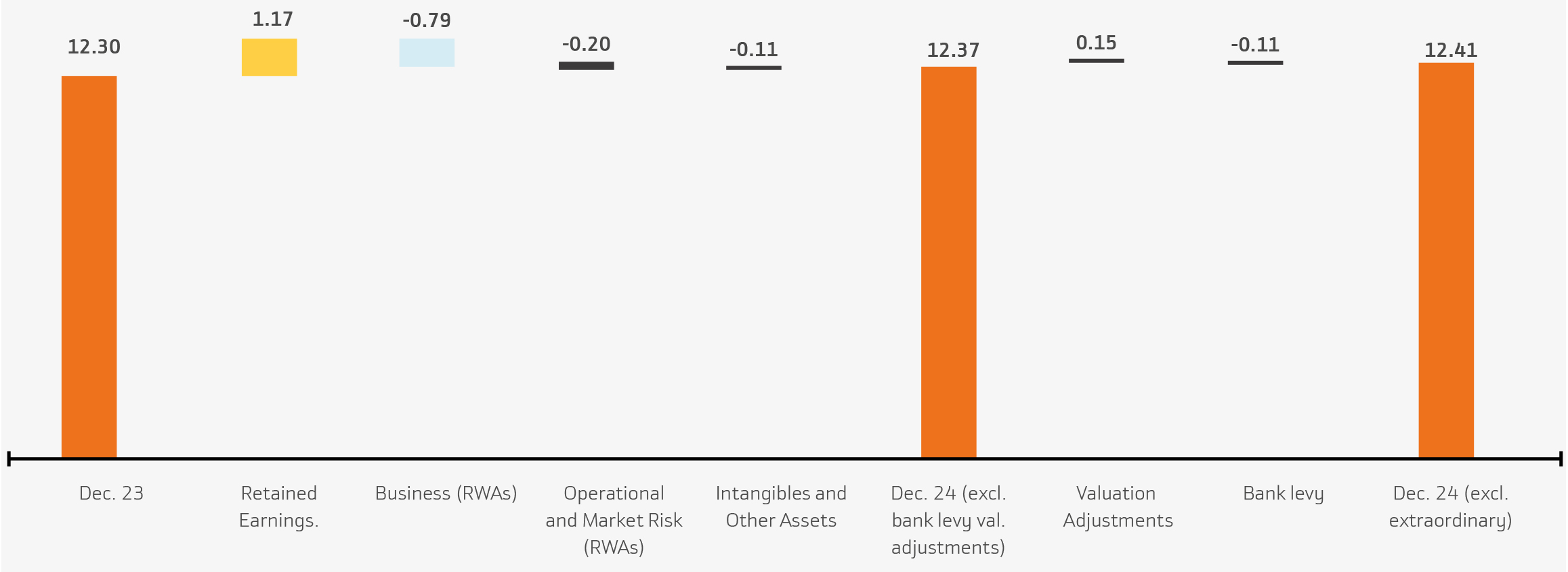
Throughout 2024, the Group continued to build the buffer of eligible liabilities to meet the MREL by generating organic capital, issuing eligible instruments and managing its balance sheet. At year-end, the level of MREL eligible instruments stood at 24.04% (20.34% excluding the capital to be dedicated to cover the combined buffer requirement of 2.7% of risk-weighted assets), and 7.88% of the leverage ratio exposure.
Improving the level of solvency
In 2024, Bankinter maintained the active and efficient management of its capital as one of its strategic priorities. The aim is to strengthen its capital adequacy position, fostering the flow of credit to households and companies without affecting its capital ratios and preserving its usual 50% pay out level.
The Group's highest-quality capital, represented by the CET1 ratio (the ratio of Common Equity Tier 1 capital to risk-weighted assets), was 12.41% at the end of the year, 11 basis points above the previous year's ratio. The increase was possible despite the growth in customer credits and the extraordinary bank levy.
The positive trends in the solvency level was supported by good results and the maintenance of the risk profile. The positive result for the year allowed the retention of 117 basis points of capital after applying the Group's traditional dividend policy (50% of profit).
Demand for credit was satisfactory. Investment in companies experienced strong growth, both nationally and internationally. The mortgage business (mitigated for capital purposes due to guarantees) continued, considering all geographies, to grow above the sector. There was growth in all other activities. As a result, business growth detracted 79 basis points from the CET1 ratio
With regard to operational risks, which is estimated according to the average of elements related to the Group's gross operating income over the last three years, it subtracted 20 basis points. Its year-on-year growth is correlated with the growth of the gross operating income. The CET's remaining items (those related to portfolios recorded at fair value) generated 15 basis points of CET1 and the bank levy subtracted 11 basis points
At the end of the reporting period, the CET1 and Total Capital ratios stood above the minimum requirement by 440 basis points (or 1.9 billion euros) and 415 basis points (or 1.8 billion euros), respectively.