Bankinter launches its fifth “CFO FrontLine Report”, which highlights that six out of ten corporates are going to increase technology investment in their finance areas
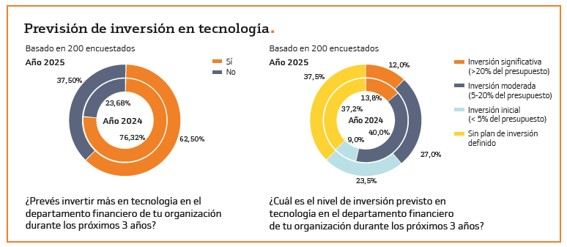
Sixty-two per cent of chief financial officers at Spanish corporates plan to increase technology investment in their finance areas over the next three years, compared to 76% in 2025, reflecting a shift towards more selective, prudent decisions focused on clear returns on investment.
The study, which focuses on robotic process automation (RPA) in finance departments, highlights that the corporates most advanced in this field view banks increasingly as suppliers of technology.
Summary of the AI press release:
Bankinter has published its fifth “CFO FrontLine Report”, which reveals that 62% of chief financial officers in Spain plan to increase investment in technology in their finance areas over the next three years. The study reflects a growing focus on robotic process automation (RPA) to improve efficiency, and also points out that the corporates most advanced in this automation perceive banks as technology suppliers rather than just financial suppliers.
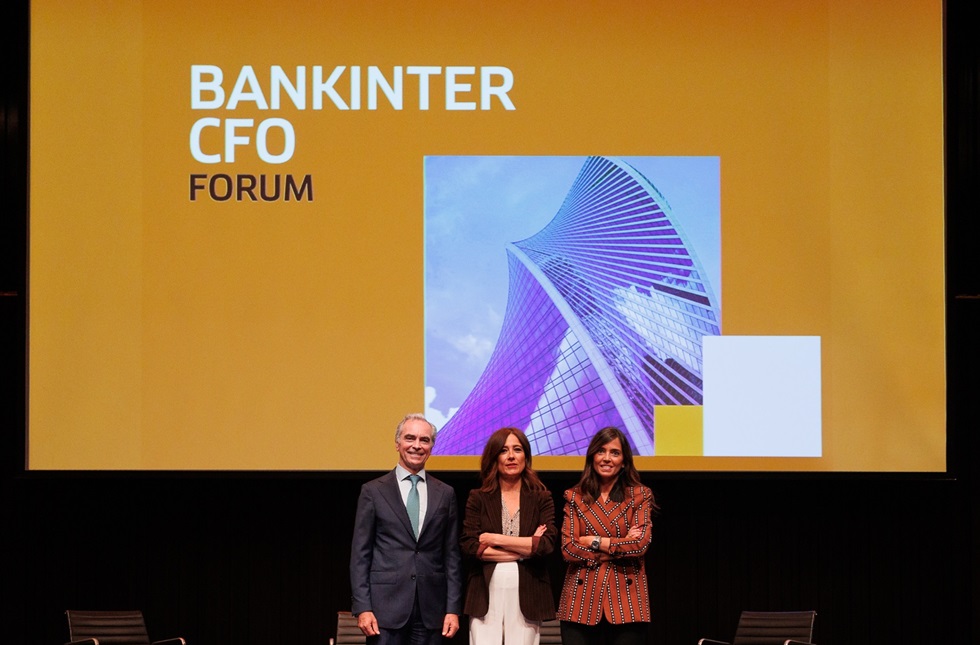
Bankinter presented its fifth “CFO FrontLine Report” at the CFO Forum, a space specifically aimed at CFOs from the Spanish business ecosystem. Maite Cañas, head of Corporate & SME Banking at Bankinter, gave the opening speech at the event, which was held in Málaga and was also attended by Jacobo Díaz, head of Finance and Digital Banking, and Olga Díaz Ramos, regional head of Bankinter in Andalucía. The report was presented by Laura de la Quintana, a journalist from El Mundo.
This latest edition of the report is centred on robotic process automation (RPA) in corporate financial departments, although, like previous editions, it also provides a comprehensive overview of these departments. One of the main conclusions is that 62% of chief financial officers at corporates plan to increase investment in technology in their areas over the next three years.
This figure is lower than the 76% recorded last year, reflecting a shift towards more cautious decisions, guided by clear investment profitability as CFOs move towards a more exploratory phase and budget restraint. As regards which finance departments are choosing to invest more in technology, this strategy is particularly evident in large corporations and the transport sector.
The study also highlights a budget-related figure: of the chief financial officers who plan to invest in technology over the next three years, 12% intend to make a significant investment of more than 20% of their department’s budget, compared to 13.8% last year. Meanwhile, 27% of the CFOs surveyed will allocate between 5% and 20% of their budget to technology, a lower percentage than the 40% reflected in the 2025 survey.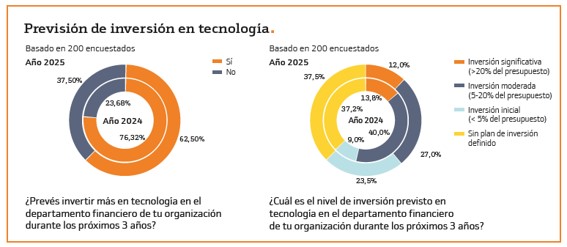
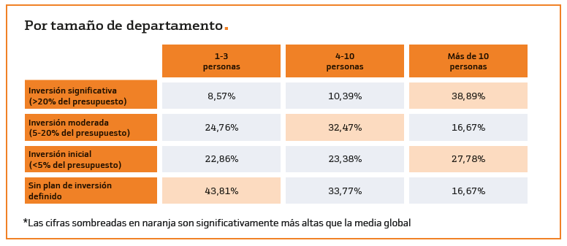
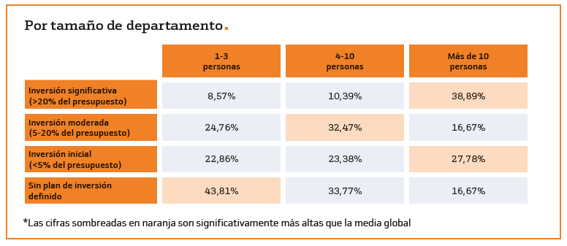
The report also shows that the size of the finance department is a determining factor when it comes to deciding whether to increase investment in this area: whereas in larger finance teams almost four out of ten (38.9%) intend to allocate more than 20% of their budget to investments, in smaller departments the absence of a clear investment plan prevails, as reported by 43.8% of CFOs managing teams of between one and three people.
Process automation: main destination of investment
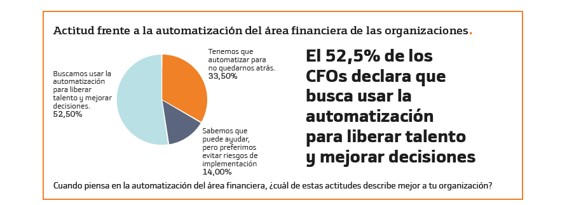
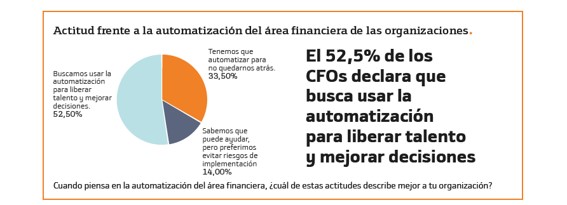
The automation of financial processes, especially through robotic process automation (RPA), is becoming one of the main focuses of technology investment in finance. Just over half of CFOs (52.5%) report that they seek to use automation to free up talent and improve decision-making, while a third, specifically 33.5%, believe that automation is an obligation to prevent the corporate from falling behind.
Currently, 55.5% of finance departments have already implemented RPA, while 34.5% are in earlier or exploratory phases. Only 10% state that they neither use this technology nor have any plans to do so.
Adoption is mainly driven by operational objectives: organisations that have automated processes report an average 44% reduction in the time spent on repetitive tasks, along with a 91.8% decrease in manual errors and a 90.41% increase in significant improvements in traceability and regulatory compliance.
Regarding the investment approach, the report highlights a significant change in the attitude of chief financial officers: 70% of CFOs define themselves as proactive or gradual in the adoption of new technologies, prioritising investments with clear use cases and tangible returns over large transformational projects.
Taken together, the data illustrate a scenario in which technology is becoming an essential infrastructure for supporting financial operations, while investment progresses unevenly according to corporate size, organisational maturity and real capacity to absorb change.
The technological role of banks
The report draws a significant conclusion regarding the role of financial institutions for corporates. Corporates characterised by mature implementation of robotic process automation, combined with artificial intelligence and data management, view their bank as a technology supplier, rather than simply a financier.
Another of the report’s findings indicates that banks have a great opportunity to add value as technology providers in corporates where robotic process automation is at an intermediate stage of maturity—that is, it forms part of their strategy, but only for very specific processes. In these cases, financial institutions can assist in the post-implementation process of robotic process automation.