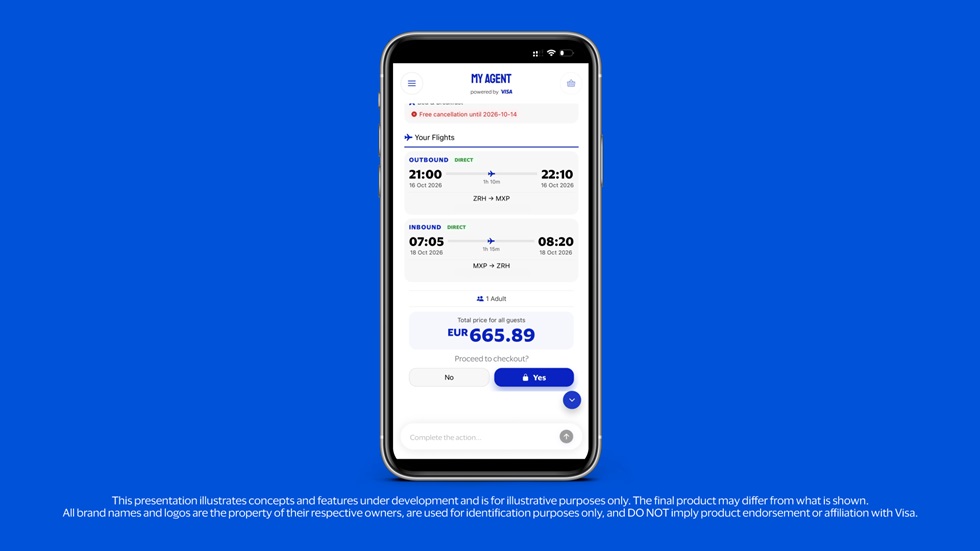
Bankinter, in partnership with Visa, has completed a transaction initiated by an AI agent as part of an agentic commerce pilot in Europe
The Bank is one of four Spanish institutions to have taken part in this initiative spearheaded by Visa.
This is an initiative carried out by the Directorate-General for Consumer Affairs, Payments, and New Businesses, which Bankinter links to its AI First programme, through which it oversees the advances in artificial intelligence within the Bank.
Summary generated with artificial intelligence:
Bankinter has completed its first transaction initiated by an artificial intelligence agent on behalf of a customer, in collaboration with Visa, as part of a real-world agentic commerce initiative that is already underway in Europe.
The transaction was carried out using real card data and the merchant's existing systems, demonstrating how AI agents can securely complete purchases on behalf of consumers within the current payments infrastructure.
The Bank is one of four Spanish institutions to have taken part in this initiative spearheaded by Visa. The Bank has decided to participate in this initiative with the goal of innovating in the field of payments.
Participation has been managed by the Directorate-General for Consumer Affairs, Payments and New Businesses, which aims to explore the opportunities offered by payments in agentic commerce, a trend that has already begun to take off.
“Bankinter wants to position itself as an innovative Bank in the world of payments, and working with Visa through the Agentic Ready programme allows us to get ahead of the agentic commerce trend in order to assess how to implement secure transactions for our customers in the future”, says Alfonso Saez, Director-General of Consumer Affairs, Payments and New Businesses.
For his part, Eduardo Prieto, Country Manager of Spain at Visa, points out that “AI agents are beginning to carry out transactions in real-world environments, and our role is to guarantee that every transaction remains secure, transparent and reliable”. He adds that, “by connecting issuers, merchants and AI systems through our network, we are enabling this next phase of commerce utilising existing infrastructure and safeguards”.
At the same time, this initiative forms part of the Bank’s AI governance programme, known as AI First, which is personally led by the CEO, Gloria Ortiz. AI First seeks to maximise the potential of this technology throughout the Bank, pursuing the maximum return on investments made and guaranteeing strict compliance with the prevailing legislation and ethical practices in its implementation. The aim is to implement AI in a pragmatic manner in order to boost productivity and efficiency within a model that combines technology and human talent, as AI is a tool at the service of human teams.
The growing role of agents in planning purchases
In the consumer world, AI agents are increasingly helping consumers to search for, compare and make purchasing decisions. As these tools evolve, they begin to play a more active role in initiating transactions on behalf of users, always operating under clearly defined permissions and controls.
This transaction, recently completed in Europe in partnership with Visa, and in which Bankinter played a key role, demonstrates how agent-initiated payments can function in everyday purchasing scenarios, fully safeguarding cardholder consent, issuer supervision and existing protections.
The transaction was facilitated through Visa Intelligent Commerce, using the same technologies that make secure digital payments possible today. These include established capabilities such as tokenisation, identity verification and real-time fraud monitoring.