



Defining ‘Noughts and Crosses’ Plan
With its ‘Noughts and Crosses’ Plan, Bankinter seeks to maximise its contributions to its economic, social and environmental milieu and to minimise its negative impacts.
The four pillars of the Plan are: excellence in provision of service, management systems, the involvement of stakeholder groups and the use of the best available technology.
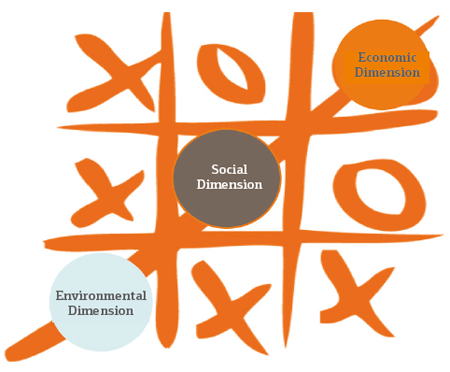
Three dimensions for a consolidated plan. The 'Noughts and Crosses' Plan was drawn up on the basis of detecting those aspects of the banking activity that have an effect on the economy, society and the environment, with the aim of minimising the negative effects and maximising the positive ones. Its preparation started out from a prior analysis which took account of some
of the major changes taking place in the current environment, such as the transformation of the economic model, the inversion of the demographic pyramid and the ageing population and climate change.
Based on this analysis, all the actions defined and implemented in the Plan are seen from three perspectives:
- Economic: through the Entrepreneurship Project, which embodies strategies focused on promoting and supporting the most innovative entrepreneurial projects, and the development of Socially Responsible Investment, which incorporates ESG (Environmental, Social and Governance) principles into the Bank's investment and financing policies.
- Social, through the ‘A Bank for All’ project, which aims to develop an inclusive bank that is fully accessible to people with different disabilities, by removing physical, cognitive and technological barriers.
- Environmental, with the implementation of measures aimed at reducing the direct and indirect environmental impact of its activity, a commitment in which strategic stakeholder groups such as employees, customers, and suppliers are involved.
The Plan was designed taking into account recognised standards such as the ISO 26000 corporate responsibility guidance and Forética's SGE21, and follows recommendations of international bodies such as the rating agencies for the DJSI and FTSE4Good sustainability indices and organisations such as the Corporate Social Responsibility Observatory and the RSE (CSR) Observatory.
This Bankinter Sustainability Plan relies on four basic pillars for its implementation:
- Quality, meaning its people's commitment to excellence in the provision of services and attention to customers' financial needs.
- The management systems, as tools for continuously improving economic, social and environmental performance, which moreover have been externally audited and certified in accordance with internationally accepted standards.
- The involvement of its strategic stakeholder groups: customers, suppliers, representatives of the non-profit and voluntary sector, and especially employees, committed and prepared through training and awareness programmes and corporate volunteer work.
- The use of the best technology available and the most innovative solutions as defining features of the Bank.
Monitoring of strategic lines
The strategic lines, objectives, goals and actions defined in the Sustainability Plan have been brought together in a scorecard so that execution of the various actions can be monitored.
The following are the degrees of attainment of the objectives set for each of the three dimensions of the Plan, and the main challenges established for 2015. A large part of the lines are in the process of being executed, given that many of the objectives proposed have been carried forward into 2015.
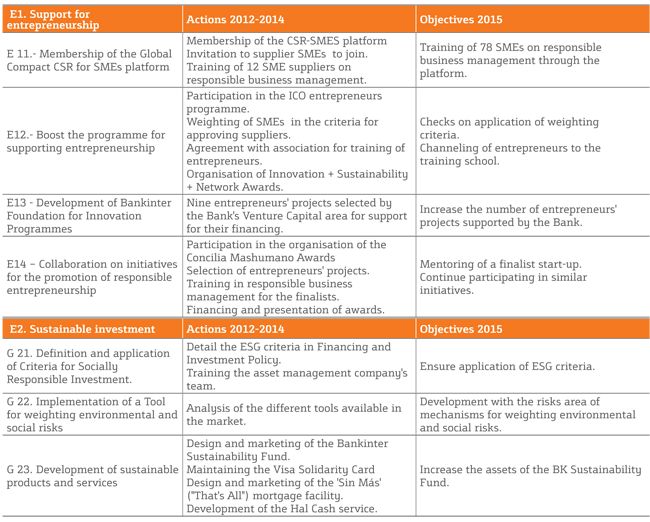
Economic Dimension
The following table shows the current degree of attainment of the objectives set in the lines of support for entrepreneurship and socially responsible investment, as well as the next challenges.
Social Dimension
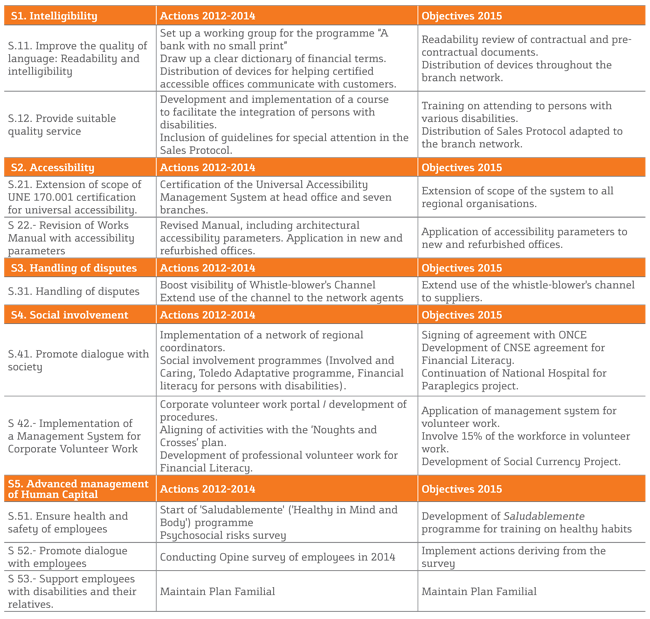
The purpose of the ‘A bank for all’ project is to continue building an inclusive bank that includes disability along the whole value chain. Within this strategy we strive to achieve maximum accessibility in all channels, with initiatives on physical, technological and cognitive accessibility. It also covers aspects relating to the treatment of disputes, developing human capital
and social involvement. The following actions were undertaken in 2014:
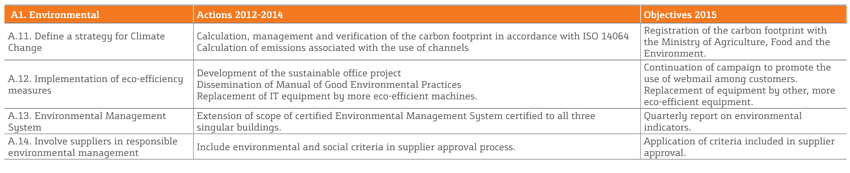
Environmental dimension
This breaks down into the following objectives and initiatives, which form part of the Carbon Footprint project, the eco-efficiency measures implemented and the certified environmental management system which has been put in place in the Bank's three singular buildings.
 Download chapter in PDF