

Corporate Governance

Structure and composition of governance

Size and composition of the Board:

The Board of Directors of Bankinter, S.A. as established by the Bank's Articles of Association and the Board Regulations, must be formed by a minimum of five and a maximum of fifteen members, who must be of recognised commercial and professional probity, have appropriate knowledge and experience for performing their functions and be in a position to exercise good governance of the Company.

The General Meeting of Shareholders determines within this range the number of directors that will form the Board of Directors. Currently, the Board of Directors of Bankinter consists of ten members. All its members are characterised by their professional capability, integrity and independent judgement. The Nominations and Remuneration Committee (now the Nominations and Corporate Governance Committee) annually verifies the status of each director, and this information is included in the Corporate Governance Report, which has to be approved by the Board of Directors and published on the Company's corporate website.

The Board currently consists of ten members, two of whom are executives and eight of whom are external. Of these eight, five are independent, two are proprietary and one is, in the Board's
opinion, neither proprietary nor independent. During 2014 the following changes took place in the composition of the Board of Directors:

  • On 25 April 2014 Mr. Pedro González Grau informed the Board of Directors of Bankinter of his decision to resign from his post as director in view of the impossibility of making his post as Director of Bankinter compatible with his new professional projects.

Directors are elected for a term of four years, and may be re-elected at the end of such term.

Bankinter's Board of Directors has an appropriate diversity of knowledge, gender and experience.

  • Executive Directors: The executive directors of Bankinter, i.e. those that perform management functions in the company or its group, irrespective of the legal connection they may have with it, are: the Vice-chairman, Cartival, S.A. (represented on the Board of Directors of Bankinter by Mr. Alfonso Botín-Sanz de Sautuola y Naveda) and the CEO, Ms. María Dolores Dancausa Treviño.
  • External proprietary directors: The Board of Directors of Bankinter, on the basis of a report by the Nominations and Remuneration Committee, classifies as external proprietary directors Messrs. Fernando Masaveu Herrero and Marcelino Botín-Sanz de Sautuola y Naveda, in view of their shareholding or designation by virtue of being shareholders, even if their shareholding does not reach such amount or in representation of shareholders.
  • Independent directors: Having evaluated the circumstances pertaining in each case, and on the basis of a favourable report from the Nomination and Remuneration Committee, the Board considers that the following directors are external independent directors: Messrs. Jaime Terceiro Lomba, Rafael Mateu de Ros, Gonzalo de la Hoz Lizcano, John de Zulueta Greenebaum and Ms. María Teresa Pulido Mendoza.

There is a balanced proportion of independent directors given the size of the Board of Directors. At present, 50% of the members of the Board of Directors are classified as independent.

  • Other external directors: Among the circumstances preventing a director's being considered as an independent director is having been an employee or executive director of the company or its Group, unless three or five years respectively have elapsed since the ending of the relationship. Mr. Pedro Guerrero Guerrero was Executive Chairman of Bankinter until 31 December 2012, when he ceased to perform his executive functions. Therefore, since the time indicated in order to be considered as an independent director has not yet elapsed, Mr. Pedro Guerrero Guerrero is considered to be in the category “Other external directors”.


Board Committees

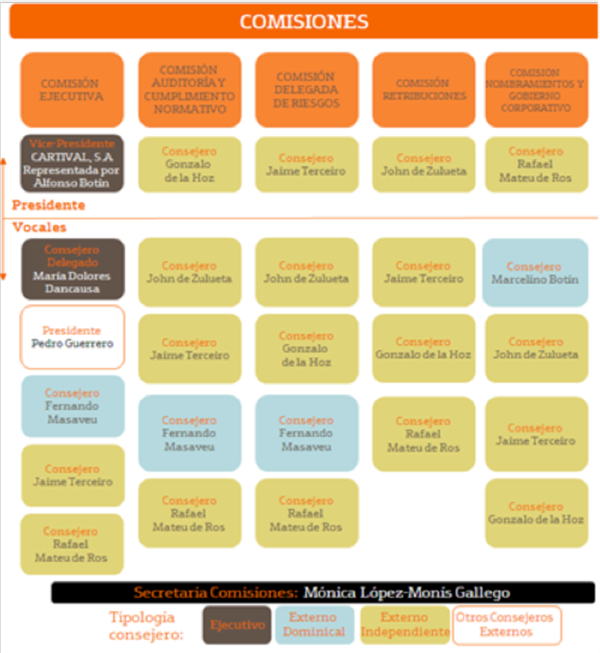
The Board has set up and delegated powers to the Executive Committee and, in relation to risk supervision, the Delegated Risks Committee. Furthermore, the Board of Directors has other committees with powers to supervise, inform, advise and propose, such as the Audit and Compliance Committee, the Remuneration Committee and the Nominations and Corporate Governance Committee, these last two recently separated, in January 2015. In the following point 1.6.2. we describe the functions and powers assigned to each of them.

The present composition of the Committees referred to is as follows:
Gender diversity

As established by the Board Regulations, it falls to the Nominations and Corporate Governance Committee to formulate and review the criteria to be followed for the composition of the Board and for the selection of candidates for the post of director. Bankinter is committed to equal opportunities for men and women, and in this regard each time it nominates members for its governing body it carries out objective selection processes, free of conditions or biases that might involve a limitation on access by women to the appointments as directors, assessing in each case the candidate's independence, professional worth, capabilities and experience in the sector. The selection process ensures that there are always women among the candidates studied.

As established by the Corporate Enterprise Act, the Nominations and Corporate Governance Committee has set an objective for representation of whichever sex is under-represented on the Board of Directors and has drawn up guidelines on how to attain this objective. Furthermore, the Committee generally uses outside advisors to carry out the selection of candidates who are likely to form part of the Board of Directors as independent directors. This Committee does not impose limitations or bias on those external advisors who carry out the tasks that might affect the choice of female directors for the post of independent director, verifies their inclusion in the list of candidates to be assessed, and encourages their inclusion in the shortlist.

With the forthcoming nomination proposals to be made at the General Meeting of Shareholders we hope to attain the objective set and thus establish a higher proportion of women on the Board of Directors.

Proof of the foregoing is the fact that in 2010 the Board appointed a woman as member of the Board of Directors and CEO. During 2014 the Board of Directors, at the proposal of the Nominations and Remuneration Committee, appointed a woman as independent director, thus reaching a proportion of 20% of women on the Board as at year-end 2014.

Bankinter continues to be committed to giving priority to candidates' professional capability and experience, irrespective of gender, as demonstrated by the fact that thee 2015 General Meeting of Shareholders will be asked to approve the proposed appointment of Rosa María García García, which if approved will considerably increase the percentage of the less represented gender on the Board over the past few years (thus reaching the objective of 30%).

Succession plans for the Chairman and the executive directors

Among the functions of the Nominations and Corporate Governance Committee is that of ensuring and reporting on the existence of upto- date succession plans for the Chairman, the executive directors and the other managers of the company and making any necessary proposals to the Board of Directors to ensure that such succession takes place in an orderly and planned manner. This report is presented to the Board of Directors annually.

Rules for in-house deputising for the Chairman

The Board Regulations include rules for the ad hoc replacement of the Chairman of the Board of Directors, both in cases where he has executive powers and in cases where he does not. In particular, they provide that the Vice-chairman will replace the Chairman in these cases.

Secretary to the Board

The Regulations of the Board of Directors include an Article on the functions of the secretary, among which are those of ensuring the legality in form and substance of the actions of the Board,
overseeing observance of the recommendations for good governance adopted by the Bank and ensuring that the procedures and rules of governance are complied with and regularly reviewed.

He must also assist the Chairman in ensuring that the directors receive the information relevant to the performance of their function in a timely manner and in an appropriate form.

Workings of the Board

The Board of Directors of Bankinter met eleven times in 2014. Prior to the start of each financial year, the Board of Directors approves the meetings schedule for the coming year and the proposed Agenda for the same, and the directors are authorised to submit additional items for inclusion on the Agenda. The calendar may be altered with the agreement of the Board itself or by the decision of the Chairman, who will make the alteration known to the Directors sufficiently in advance, except in case of urgency. The minimum number of meetings shall be ten per year (well in excess of the legal requirement to hold meetings once a quarter).

Sufficient notice must be given prior to the date of the meeting, except in cases of urgency or necessity. Notice must always include the meeting's Agenda and be accompanied by the informative documentation previously set by the Board, or which the Chairman decides in each case. The Directors may ask the Chairman or the Secretary to the Board to supply them with the information that is necessary to carry out an appropriate assessment of the corresponding transactions or decisions, in such a way that they can reasonably prepare for the meetings and actively take part in the deliberations.

Conduct of the meetings

In 2014 the Board of Directors, either directly or through its Committees, was kept informed of the progress and activity of the Bankinter Group's various business areas and of their plans for the future. The Board also dealt with other general matters within the scope of its supervisory functions. The Board was informed of the conclusions of the various internal and external audit reports, among many other matters covered, such as the management and control of the risks associated with the Bankinter Group.

Dedication to the tasks of the Board

Directors are obliged to devote the necessary time and effort to ensuring the effective performance of their office, and in any case to comply with the limits on the maximum number of Boards to which they may belong, as established by Law.

Directors must ensure that absences from meetings of the Board of Directors and of the Committees of which they are members are limited to unavoidable cases.

The Nominations and Corporate Governance Committee will evaluate the balance of the necessary skills, abilities, knowledge, diversity and experience on the Board of Directors. For this purpose it shall define the functions and aptitudes necessary in the candidates who are to fill each vacancy, and assess the time and dedication required for them to properly perform their function.

Self-assessment of the Board and its delegated committees

One of the Board's powers is to produce an annual assessment of its own workings and those of its committees and, based on its conclusions, to propose an action plan to correct the shortcomings detected. In the last few assessments no significant weaknesses were detected such as would oblige the Board to take measures, although the company has implemented some suggestions that were drawn from the last few selfassessments.

Nomination, re-election and ratification of directors

Since the coming into force of the amendments to the Corporate Enterprise Act, as transposed into the Board Regulations, proposals for nomination, re-election and ratification of directors submitted by the Board of Directors for the consideration of the General Meeting of Shareholders and the decisions taken by the Board by virtue of its powers of co-optation as established in the Articles of Association must in turn be preceded by the proposal of the Nominations and Corporate Governance Committee in the case of independent directors and by that of the Board of Directors in the case of other categories of directors.

Also, these proposals and decisions must always be preceded by a report from the Board of Directors justifying them, and in the case of independent Directors, also by a report of the Nominations and Corporate Governance Committee.

Directors' duties, related party transactions and situations of conflict of interest

The Directors' duties are covered by the Regulations of the Board of Directors, which is in line with the provisions of Spanish law. The Board Regulations expressly refer, among others, to the duties of diligent administration, loyalty, secrecy and impartiality in the case of knowledge of reserved information.

The duty of diligent administration includes the duty to keep themselves appropriately informed of the Bank's progress and to devote to their office the time and effort necessary for its effective performance.

Functions of the governing bodies

Functions of the Board of Directors which cannot be delegated

Following the amendment to the Corporate Enterprise Act, which introduces improvements in the area of corporate governance, and the approval of the Law on the organisation, supervision and solvency of credit institutions, the powers vested in the Board of Directors are those set out hereunder, as contained in the Board Regulations:

  • Determining the company's general policies and strategies, and in particular, approving the strategic or business plan, the annual management and budget objective, the investment and financing policy, the corporate social responsibility policy and the dividend policy, at both individual and group levels.
  • Determining the policy for the control and management of risks, including tax risks, and supervising the internal information and control systems. To this end, to approve the policy for the control and management of risk, as well as the periodic monitoring of the internal information and control systems, including the risk associated with the marketing of products and transparency with clients, as well as compliance with the rules on professional ethics and the conduct of the securities market, and those relating to privileged and significant information.
  • Determining the company's tax strategy.
  • Determining the company's and its group's corporate governance policy; its organisation and functioning and, in particular, approving and amending its own regulations.
  • Supervision of the effective functioning of such committees as it may have set up and of the actions of the delegated bodies and of the managers it has appointed. n Defining the structure of the group of companies headed up by the company.
  • Drawing up annual financial statements and presenting them to the General Meeting of Shareholders.
  • Approving the financial information which, as a listed company, the Bank must publish periodically and in any case, approving the quarterly, half-yearly and annual results of the Company and the Group as verified by the Audit and Compliance Committee prior to their publication.
  • Drawing up any kind of report required of the governing body by law providing the operation referred to by the report cannot be delegated.
  • Approving the policies on information to and communication with shareholders, the markets and public opinion. The Board shall be responsible for supplying the markets with fast, accurate and reliable information, especially concerning the shareholding structure, substantial changes to the rules of governance, related party transactions of special importance or treasury stock.
  • Ensuring the creation of value in the long term for shareholders, the company, its employees and customers and society as a whole, as well as the solvency, leadership, brand image, innovation, competitiveness, growth and profitability of the Bank and of the Group.
  • The approval of investments or transactions of all types, which as a result of their magnitude or special characteristics, are of a strategic nature, or special tax risk, unless the approval corresponds to the General Meeting of Shareholders.
  • Approval of the creation or acquisition of participations in companies which have a special purpose or which are domiciled in countries or territories which are deemed to be tax havens, as well as any other transactions or operations of a similar nature which, given their complexity, may reduce the transparency of the company and its group.
  • Approving, subject to a previous report by the Audit and Compliance Committee, transactions that the company or companies in its group carry out with directors, in the terms established by the law, in the Articles of Association and in these regulations, or with shareholders holding a significant stake, individually or together with others, including shareholders represented on the company's Board of Directors or on the Board of other companies forming part of the same group or with persons related to them. The directors concerned or the directors they represent or who are related to the shareholders concerned shall abstain from the deliberation and voting on the resolution on this matter. The only exceptions to this approval will be transactions having all the  following characteristics at the same time:
  1. They are carried out by virtue of contracts where the conditions are standardised and are applied to a large number of customers.
  2. Those carried out at prices or rates established in a general manner by the person who acts as supplier of the goods or service being dealt with.
  3. The amount does not exceed one per cent of the company's annual income.
  • Authorisation or dispensation is held from the obligations deriving from the duty of loyalty in accordance with the law.
  • The appointment and removal of the company's managing directors, and the setting of the terms of their contracts.
  • The appointment and removal of managers reporting directly to the Board or to one of its members, and the setting of the basic terms of their contracts, including their remuneration.
  • Decisions relating to directors' remuneration, within the statutory framework and, if applicable, the remuneration policy approved by the General Meeting of Shareholders.
  • Calling the General Meeting of Shareholders, drawing up the agenda and proposing the resolutions.
  • The policy on treasury stock.
  • Such powers as the General Meeting of Shareholders may have delegated to the Board of Directors, unless it has explicitly authorised their sub-delegation.
  • And those specifically referred to in the Regulations of the Board of Directors.

Functions of the Board Committees:

Executive Committee

The Executive Committee exercises, by delegation, all the powers of the Board, except for those that cannot be delegated by law or pursuant to the Articles of Association or the Board Regulations, and assumes the day-to-day management of the business. It reports regularly to the Board of Directors on matters dealt with by it, and provides the directors with copies of the minutes of its meetings. It meets with the same frequency as the Board of Directors. Its functions, composition and workings are regulated by Article 34 of the Regulations of the Board of Directors.

Delegated Risks Committee

This committee has the delegated powers referring to the supervision and control of risks. It meets quarterly. The functions assigned to it include:

  • Advising the Board of Directors on the Bank's overall propensity to present and future risk, and its strategy in this area, and assisting it in overseeing the application of this strategy. Notwithstanding the foregoing, the Board of Directors shall retain overall responsibility for risks. n Examining the prices of the assets and liabilities offered to customers to ensure that they fully take account of the Bank's business model and risk strategy. If they do not, the Delegated Risks Committee will present a corrective plan to the Board of Directors.
  • Determining, together with the Board of Directors, the nature, quantity, format and frequency of the information on risks that the Committee itself and the Board of Directors should receive.
  • Collaborating on the establishment of rational remuneration policies and practices. To this end, without prejudice to the functions of the Remuneration Committee, the Delegated Risks Committee shall examine the incentives provided for in the remuneration system, to see whether they take account of risk, capital, liquidity and probability and appropriateness of profits. n Approving, at the proposal of the Chairman of the Board, the Vice-chairman if executive, or the CEO, the appointment or replacement of the Chief Risk Officer.

Its functions, composition and workings are regulated by Article 36 of the Regulations of the Board of Directors.

Audit and Compliance Committee

The Audit and Compliance Committee, among many other functions, reviews the Group's financial information and its risk control and management systems, serves as a channel of communication between the Board and the auditors, overseeing the independent performance of the latter's role, supervises the work of the internal audit and takes note of the reports issued by the supervisory authorities. It meets monthly.

Its functions, composition and workings are regulated by Article 35 of the Regulations of the Board of Directors. The Audit and Compliance Committee has drawn up a report on its activities in 2014, which is made available to shareholders as part of the documentation for the General Meeting of Shareholders.

Remuneration Committee

The Remuneration Committee, which was split off from the Nominations Committee in January 2015, proposes to the Board, among other things, the policy on Directors' remuneration, producing the corresponding report, and the remuneration policy for senior management and key personnel of the Group.

Its functions, composition and workings are regulated by Article 37 of the Regulations of the Board of Directors.

Nominations and Corporate Governance Committee

The Nominations and Corporate Governance Committee, which in January 2015 was separated from the Remuneration Committee and combined with the Corporate Governance Committee, proposes to the Board, inter alia, the nomination, ratification, re-election and removal of independent Directors, ensures that when there are vacancies the selection procedures do not suffer from implicit biases hindering the selection of female directors, seeking to include among potential candidates women with the professional profile sought, and evaluates the balance of skills, capability, knowledge, diversity and experience necessary on the Board of Directors.

Its functions, composition and workings are regulated by Article 38 of the Regulations of the Board of Directors.

Remuneration and incentives

Description of the remuneration system

The General Meeting of Shareholders is the competent body for approving the annual maximum amount corresponding by way of remuneration to the Directors as a whole in their capacity as such. This amount shall remain in force until such time as the general meeting of shareholders shall resolve to change it, although the Board may reduce its amount in years in which it considers this justified.

The specific establishment of the amount corresponding under the headings set out in the Articles of Association to each director and the form of payment shall be performed by the Board of Directors. In so doing it shall take account of the roles fulfilled by each director in the board itself and his or her membership of the various committees and attendance record.

At present, this remuneration has two components: a fixed annual fee and attendance fees.

Directors shall be entitled to receive such remunerations (salaries, incentives, bonuses, pensions, insurance and indemnities) as at the proposal of the Remuneration Committee and by agreement of the Board of Directors are considered appropriate for the performance in the Company of functions, whether as executive director or otherwise, other than those of collegiate supervision and decision performed purely in their status as members of the Board.

The variable components of remuneration shall be set such as to produce an appropriate ratio between fixed and variable components of total remuneration.

The variable components shall not exceed one hundred per cent of the fixed components of the total remuneration of each director, unless the general meeting of shareholders approves a higher ratio, which in no case may exceed two hundred per cent of the fixed components of total remuneration, in the terms established by law.

This remuneration may be consulted in the Annual Report on Directors' Remuneration which is submitted to a consultative vote at the General Meeting of Shareholders.

Anticipation of, and adaptation to, the regulatory framework

The Board of Directors, at the proposal of the Remuneration Committee, promotes and drives a remuneration system that encourages rigorous risk management and continually monitors the recommendations of the major national and international bodies.

Report on the policy for directors' remuneration

Law 2/2011 of 4 March on Sustainable Economy, in its fifth final provision, incorporated a number of amendments to the Securities Market Act, in application of the principles of good corporate governance emanating from international agreements and bodies, and with the purpose of reinforcing transparency in relation to the remuneration of its directors and senior management, as well as its remuneration policies. In this manner, a new article 61 ter was added to the Securities Market Act, on the annual report on directors’ remuneration, establishing, among other issues, that said report must be submitted for consultative voting at the General Meeting of Shareholders. Subsequently, and in implementation of this Law, Ministerial Order ECC/461/2013 of 20 March was issued, determining the content and structure of the annual report on corporate governance, the annual report on remuneration and other reporting instruments of listed companies. The provisions of Ministerial Order ECC/461/2013 of 20 March complete the regulation of the content and structure of the annual report on directors' remuneration and empower the CNMV to detail, in accordance with the provisions of the Order, the content and structure of the reports on remuneration, to which end Circular 4/2013 was approved, determining, inter alia, the model for the annual report on directors' remuneration of listed companies. The aforementioned requirements have since been incorporated into the Corporate Enterprise Act, which in essence pursues the same end as the aforementioned Articles of the Securities Market Act, which have now been abolished. One of the new features introduced is the obligation to submit the policy for directors' remuneration to a binding vote every three years; there is a transitional provision which establishes that if the 2015 Ordinary General Meeting of Shareholders approves the report on directors' remuneration on a consultative basis, the company's policy on remuneration as contained therein shall also be understood to have been approved for the purposes of Article 529 (19) of the Corporate Enterprise Act, and said Article shall apply to the Company thenceforth.

As part of its policy of good governance, Bankinter decided to apply and comply with the recommendation of the Spanish Unified Code of Good Governance from its entry into force with respect to submission of its report on the policy of directors' remunerations to the Shareholders General Meetings as a separate point on the Agenda in a consultative capacity. Hence, since 2008 the Bank's shareholders have had the opportunity to make an express decision in regard to said policy. In the 2014 AGM 96.512% of votes present or represented were in favour (84.739% in 2013).

Transparency

The notes to the financial statements provide individualised information on the remuneration received, by director, with the amounts corresponding to each element of remuneration. The notes to the financial statements also provide information, individualised and by item, on remuneration corresponding to executive functions entrusted to the Bank's executive directors.


Corporate Governance

Structure and composition of governance

Size and composition of the Board:

The Board of Directors of Bankinter, S.A. as established by the Bank's Articles of Association and the Board Regulations, must be formed by a minimum of five and a maximum of fifteen members, who must be of recognised commercial and professional probity, have appropriate knowledge and experience for performing their functions and be in a position to exercise good governance of the Company.

The General Meeting of Shareholders determines within this range the number of directors that will form the Board of Directors. Currently, the Board of Directors of Bankinter consists of ten members. All its members are characterised by their professional capability, integrity and independent judgement. The Nominations and Remuneration Committee (now the Nominations and Corporate Governance Committee) annually verifies the status of each director, and this information is included in the Corporate Governance Report, which has to be approved by the Board of Directors and published on the Company's corporate website.

The Board currently consists of ten members, two of whom are executives and eight of whom are external. Of these eight, five are independent, two are proprietary and one is, in the Board's
opinion, neither proprietary nor independent. During 2014 the following changes took place in the composition of the Board of Directors:

  • On 25 April 2014 Mr. Pedro González Grau informed the Board of Directors of Bankinter of his decision to resign from his post as director in view of the impossibility of making his post as Director of Bankinter compatible with his new professional projects.

Directors are elected for a term of four years, and may be re-elected at the end of such term.

Bankinter's Board of Directors has an appropriate diversity of knowledge, gender and experience.

  • Executive Directors: The executive directors of Bankinter, i.e. those that perform management functions in the company or its group, irrespective of the legal connection they may have with it, are: the Vice-chairman, Cartival, S.A. (represented on the Board of Directors of Bankinter by Mr. Alfonso Botín-Sanz de Sautuola y Naveda) and the CEO, Ms. María Dolores Dancausa Treviño.
  • External proprietary directors: The Board of Directors of Bankinter, on the basis of a report by the Nominations and Remuneration Committee, classifies as external proprietary directors Messrs. Fernando Masaveu Herrero and Marcelino Botín-Sanz de Sautuola y Naveda, in view of their shareholding or designation by virtue of being shareholders, even if their shareholding does not reach such amount or in representation of shareholders.
  • Independent directors: Having evaluated the circumstances pertaining in each case, and on the basis of a favourable report from the Nomination and Remuneration Committee, the Board considers that the following directors are external independent directors: Messrs. Jaime Terceiro Lomba, Rafael Mateu de Ros, Gonzalo de la Hoz Lizcano, John de Zulueta Greenebaum and Ms. María Teresa Pulido Mendoza.

There is a balanced proportion of independent directors given the size of the Board of Directors. At present, 50% of the members of the Board of Directors are classified as independent.

  • Other external directors: Among the circumstances preventing a director's being considered as an independent director is having been an employee or executive director of the company or its Group, unless three or five years respectively have elapsed since the ending of the relationship. Mr. Pedro Guerrero Guerrero was Executive Chairman of Bankinter until 31 December 2012, when he ceased to perform his executive functions. Therefore, since the time indicated in order to be considered as an independent director has not yet elapsed, Mr. Pedro Guerrero Guerrero is considered to be in the category “Other external directors”.

Board Committees

The Board has set up and delegated powers to the Executive Committee and, in relation to risk supervision, the Delegated Risks Committee. Furthermore, the Board of Directors has other committees with powers to supervise, inform, advise and propose, such as the Audit and Compliance Committee, the Remuneration Committee and the Nominations and Corporate Governance Committee, these last two recently separated, in January 2015. In the following point 1.6.2. we describe the functions and powers assigned to each of them.

The present composition of the Committees referred to is as follows:

Gender diversity

As established by the Board Regulations, it falls to the Nominations and Corporate Governance Committee to formulate and review the criteria to be followed for the composition of the Board and for the selection of candidates for the post of director. Bankinter is committed to equal opportunities for men and women, and in this regard each time it nominates members for its governing body it carries out objective selection processes, free of conditions or biases that might involve a limitation on access by women to the appointments as directors, assessing in each case the candidate's independence, professional worth, capabilities and experience in the sector. The selection process ensures that there are always women among the candidates studied.

As established by the Corporate Enterprise Act, the Nominations and Corporate Governance Committee has set an objective for representation of whichever sex is under-represented on the Board of Directors and has drawn up guidelines on how to attain this objective. Furthermore, the Committee generally uses outside advisors to carry out the selection of candidates who are likely to form part of the Board of Directors as independent directors. This Committee does not impose limitations or bias on those external advisors who carry out the tasks that might affect the choice of female directors for the post of independent director, verifies their inclusion in the list of candidates to be assessed, and encourages their inclusion in the shortlist.

With the forthcoming nomination proposals to be made at the General Meeting of Shareholders we hope to attain the objective set and thus establish a higher proportion of women on the Board of Directors.

Proof of the foregoing is the fact that in 2010 the Board appointed a woman as member of the Board of Directors and CEO. During 2014 the Board of Directors, at the proposal of the Nominations and Remuneration Committee, appointed a woman as independent director, thus reaching a proportion of 20% of women on the Board as at year-end 2014.

Bankinter continues to be committed to giving priority to candidates' professional capability and experience, irrespective of gender, as demonstrated by the fact that thee 2015 General Meeting of Shareholders will be asked to approve the proposed appointment of Rosa María García García, which if approved will considerably increase the percentage of the less represented gender on the Board over the past few years (thus reaching the objective of 30%).

Succession plans for the Chairman and the executive directors

Among the functions of the Nominations and Corporate Governance Committee is that of ensuring and reporting on the existence of upto- date succession plans for the Chairman, the executive directors and the other managers of the company and making any necessary proposals to the Board of Directors to ensure that such succession takes place in an orderly and planned manner. This report is presented to the Board of Directors annually.

Rules for in-house deputising for the Chairman

The Board Regulations include rules for the ad hoc replacement of the Chairman of the Board of Directors, both in cases where he has executive powers and in cases where he does not. In particular, they provide that the Vice-chairman will replace the Chairman in these cases.

Secretary to the Board

The Regulations of the Board of Directors include an Article on the functions of the secretary, among which are those of ensuring the legality in form and substance of the actions of the Board,
overseeing observance of the recommendations for good governance adopted by the Bank and ensuring that the procedures and rules of governance are complied with and regularly reviewed.

He must also assist the Chairman in ensuring that the directors receive the information relevant to the performance of their function in a timely manner and in an appropriate form.

Workings of the Board

The Board of Directors of Bankinter met eleven times in 2014. Prior to the start of each financial year, the Board of Directors approves the meetings schedule for the coming year and the proposed Agenda for the same, and the directors are authorised to submit additional items for inclusion on the Agenda. The calendar may be altered with the agreement of the Board itself or by the decision of the Chairman, who will make the alteration known to the Directors sufficiently in advance, except in case of urgency. The minimum number of meetings shall be ten per year (well in excess of the legal requirement to hold meetings once a quarter).

Sufficient notice must be given prior to the date of the meeting, except in cases of urgency or necessity. Notice must always include the meeting's Agenda and be accompanied by the informative documentation previously set by the Board, or which the Chairman decides in each case. The Directors may ask the Chairman or the Secretary to the Board to supply them with the information that is necessary to carry out an appropriate assessment of the corresponding transactions or decisions, in such a way that they can reasonably prepare for the meetings and actively take part in the deliberations.

Conduct of the meetings

In 2014 the Board of Directors, either directly or through its Committees, was kept informed of the progress and activity of the Bankinter Group's various business areas and of their plans for the future. The Board also dealt with other general matters within the scope of its supervisory functions. The Board was informed of the conclusions of the various internal and external audit reports, among many other matters covered, such as the management and control of the risks associated with the Bankinter Group.

Dedication to the tasks of the Board

Directors are obliged to devote the necessary time and effort to ensuring the effective performance of their office, and in any case to comply with the limits on the maximum number of Boards to which they may belong, as established by Law.

Directors must ensure that absences from meetings of the Board of Directors and of the Committees of which they are members are limited to unavoidable cases.

The Nominations and Corporate Governance Committee will evaluate the balance of the necessary skills, abilities, knowledge, diversity and experience on the Board of Directors. For this purpose it shall define the functions and aptitudes necessary in the candidates who are to fill each vacancy, and assess the time and dedication required for them to properly perform their function.

Self-assessment of the Board and its delegated committees

One of the Board's powers is to produce an annual assessment of its own workings and those of its committees and, based on its conclusions, to propose an action plan to correct the shortcomings detected. In the last few assessments no significant weaknesses were detected such as would oblige the Board to take measures, although the company has implemented some suggestions that were drawn from the last few selfassessments.

Nomination, re-election and ratification of directors

Since the coming into force of the amendments to the Corporate Enterprise Act, as transposed into the Board Regulations, proposals for nomination, re-election and ratification of directors submitted by the Board of Directors for the consideration of the General Meeting of Shareholders and the decisions taken by the Board by virtue of its powers of co-optation as established in the Articles of Association must in turn be preceded by the proposal of the Nominations and Corporate Governance Committee in the case of independent directors and by that of the Board of Directors in the case of other categories of directors.

Also, these proposals and decisions must always be preceded by a report from the Board of Directors justifying them, and in the case of independent Directors, also by a report of the Nominations and Corporate Governance Committee.

Directors' duties, related party transactions and situations of conflict of interest

The Directors' duties are covered by the Regulations of the Board of Directors, which is in line with the provisions of Spanish law. The Board Regulations expressly refer, among others, to the duties of diligent administration, loyalty, secrecy and impartiality in the case of knowledge of reserved information.

The duty of diligent administration includes the duty to keep themselves appropriately informed of the Bank's progress and to devote to their office the time and effort necessary for its effective performance.

Functions of the governing bodies

Functions of the Board of Directors which cannot be delegated

Following the amendment to the Corporate Enterprise Act, which introduces improvements in the area of corporate governance, and the approval of the Law on the organisation, supervision and solvency of credit institutions, the powers vested in the Board of Directors are those set out hereunder, as contained in the Board Regulations:

  • Determining the company's general policies and strategies, and in particular, approving the strategic or business plan, the annual management and budget objective, the investment and financing policy, the corporate social responsibility policy and the dividend policy, at both individual and group levels.
  • Determining the policy for the control and management of risks, including tax risks, and supervising the internal information and control systems. To this end, to approve the policy for the control and management of risk, as well as the periodic monitoring of the internal information and control systems, including the risk associated with the marketing of products and transparency with clients, as well as compliance with the rules on professional ethics and the conduct of the securities market, and those relating to privileged and significant information.
  • Determining the company's tax strategy.
  • Determining the company's and its group's corporate governance policy; its organisation and functioning and, in particular, approving and amending its own regulations.
  • Supervision of the effective functioning of such committees as it may have set up and of the actions of the delegated bodies and of the managers it has appointed. n Defining the structure of the group of companies headed up by the company.
  • Drawing up annual financial statements and presenting them to the General Meeting of Shareholders.
  • Approving the financial information which, as a listed company, the Bank must publish periodically and in any case, approving the quarterly, half-yearly and annual results of the Company and the Group as verified by the Audit and Compliance Committee prior to their publication.
  • Drawing up any kind of report required of the governing body by law providing the operation referred to by the report cannot be delegated.
  • Approving the policies on information to and communication with shareholders, the markets and public opinion. The Board shall be responsible for supplying the markets with fast, accurate and reliable information, especially concerning the shareholding structure, substantial changes to the rules of governance, related party transactions of special importance or treasury stock.
  • Ensuring the creation of value in the long term for shareholders, the company, its employees and customers and society as a whole, as well as the solvency, leadership, brand image, innovation, competitiveness, growth and profitability of the Bank and of the Group.
  • The approval of investments or transactions of all types, which as a result of their magnitude or special characteristics, are of a strategic nature, or special tax risk, unless the approval corresponds to the General Meeting of Shareholders.
  • Approval of the creation or acquisition of participations in companies which have a special purpose or which are domiciled in countries or territories which are deemed to be tax havens, as well as any other transactions or operations of a similar nature which, given their complexity, may reduce the transparency of the company and its group.
  • Approving, subject to a previous report by the Audit and Compliance Committee, transactions that the company or companies in its group carry out with directors, in the terms established by the law, in the Articles of Association and in these regulations, or with shareholders holding a significant stake, individually or together with others, including shareholders represented on the company's Board of Directors or on the Board of other companies forming part of the same group or with persons related to them. The directors concerned or the directors they represent or who are related to the shareholders concerned shall abstain from the deliberation and voting on the resolution on this matter. The only exceptions to this approval will be transactions having all the  following characteristics at the same time:
  1. They are carried out by virtue of contracts where the conditions are standardised and are applied to a large number of customers.
  2. Those carried out at prices or rates established in a general manner by the person who acts as supplier of the goods or service being dealt with.
  3. The amount does not exceed one per cent of the company's annual income.
  • Authorisation or dispensation is held from the obligations deriving from the duty of loyalty in accordance with the law.
  • The appointment and removal of the company's managing directors, and the setting of the terms of their contracts.
  • The appointment and removal of managers reporting directly to the Board or to one of its members, and the setting of the basic terms of their contracts, including their remuneration.
  • Decisions relating to directors' remuneration, within the statutory framework and, if applicable, the remuneration policy approved by the General Meeting of Shareholders.
  • Calling the General Meeting of Shareholders, drawing up the agenda and proposing the resolutions.
  • The policy on treasury stock.
  • Such powers as the General Meeting of Shareholders may have delegated to the Board of Directors, unless it has explicitly authorised their sub-delegation.
  • And those specifically referred to in the Regulations of the Board of Directors.

Functions of the Board Committees:

Executive Committee

The Executive Committee exercises, by delegation, all the powers of the Board, except for those that cannot be delegated by law or pursuant to the Articles of Association or the Board Regulations, and assumes the day-to-day management of the business. It reports regularly to the Board of Directors on matters dealt with by it, and provides the directors with copies of the minutes of its meetings. It meets with the same frequency as the Board of Directors. Its functions, composition and workings are regulated by Article 34 of the Regulations of the Board of Directors.

Delegated Risks Committee

This committee has the delegated powers referring to the supervision and control of risks. It meets quarterly. The functions assigned to it include:

  • Advising the Board of Directors on the Bank's overall propensity to present and future risk, and its strategy in this area, and assisting it in overseeing the application of this strategy. Notwithstanding the foregoing, the Board of Directors shall retain overall responsibility for risks. n Examining the prices of the assets and liabilities offered to customers to ensure that they fully take account of the Bank's business model and risk strategy. If they do not, the Delegated Risks Committee will present a corrective plan to the Board of Directors.
  • Determining, together with the Board of Directors, the nature, quantity, format and frequency of the information on risks that the Committee itself and the Board of Directors should receive.
  • Collaborating on the establishment of rational remuneration policies and practices. To this end, without prejudice to the functions of the Remuneration Committee, the Delegated Risks Committee shall examine the incentives provided for in the remuneration system, to see whether they take account of risk, capital, liquidity and probability and appropriateness of profits. n Approving, at the proposal of the Chairman of the Board, the Vice-chairman if executive, or the CEO, the appointment or replacement of the Chief Risk Officer.

Its functions, composition and workings are regulated by Article 36 of the Regulations of the Board of Directors.

Audit and Compliance Committee

The Audit and Compliance Committee, among many other functions, reviews the Group's financial information and its risk control and management systems, serves as a channel of communication between the Board and the auditors, overseeing the independent performance of the latter's role, supervises the work of the internal audit and takes note of the reports issued by the supervisory authorities. It meets monthly.

Its functions, composition and workings are regulated by Article 35 of the Regulations of the Board of Directors. The Audit and Compliance Committee has drawn up a report on its activities in 2014, which is made available to shareholders as part of the documentation for the General Meeting of Shareholders.

Remuneration Committee

The Remuneration Committee, which was split off from the Nominations Committee in January 2015, proposes to the Board, among other things, the policy on Directors' remuneration, producing the corresponding report, and the remuneration policy for senior management and key personnel of the Group.

Its functions, composition and workings are regulated by Article 37 of the Regulations of the Board of Directors.

Nominations and Corporate Governance Committee

The Nominations and Corporate Governance Committee, which in January 2015 was separated from the Remuneration Committee and combined with the Corporate Governance Committee, proposes to the Board, inter alia, the nomination, ratification, re-election and removal of independent Directors, ensures that when there are vacancies the selection procedures do not suffer from implicit biases hindering the selection of female directors, seeking to include among potential candidates women with the professional profile sought, and evaluates the balance of skills, capability, knowledge, diversity and experience necessary on the Board of Directors.

Its functions, composition and workings are regulated by Article 38 of the Regulations of the Board of Directors.

Remuneration and incentives

Description of the remuneration system

The General Meeting of Shareholders is the competent body for approving the annual maximum amount corresponding by way of remuneration to the Directors as a whole in their capacity as such. This amount shall remain in force until such time as the general meeting of shareholders shall resolve to change it, although the Board may reduce its amount in years in which it considers this justified.

The specific establishment of the amount corresponding under the headings set out in the Articles of Association to each director and the form of payment shall be performed by the Board of Directors. In so doing it shall take account of the roles fulfilled by each director in the board itself and his or her membership of the various committees and attendance record.

At present, this remuneration has two components: a fixed annual fee and attendance fees.

Directors shall be entitled to receive such remunerations (salaries, incentives, bonuses, pensions, insurance and indemnities) as at the proposal of the Remuneration Committee and by agreement of the Board of Directors are considered appropriate for the performance in the Company of functions, whether as executive director or otherwise, other than those of collegiate supervision and decision performed purely in their status as members of the Board.

The variable components of remuneration shall be set such as to produce an appropriate ratio between fixed and variable components of total remuneration.

The variable components shall not exceed one hundred per cent of the fixed components of the total remuneration of each director, unless the general meeting of shareholders approves a higher ratio, which in no case may exceed two hundred per cent of the fixed components of total remuneration, in the terms established by law.

This remuneration may be consulted in the Annual Report on Directors' Remuneration which is submitted to a consultative vote at the General Meeting of Shareholders.

Anticipation of, and adaptation to, the regulatory framework

The Board of Directors, at the proposal of the Remuneration Committee, promotes and drives a remuneration system that encourages rigorous risk management and continually monitors the recommendations of the major national and international bodies.

Report on the policy for directors' remuneration

Law 2/2011 of 4 March on Sustainable Economy, in its fifth final provision, incorporated a number of amendments to the Securities Market Act, in application of the principles of good corporate governance emanating from international agreements and bodies, and with the purpose of reinforcing transparency in relation to the remuneration of its directors and senior management, as well as its remuneration policies. In this manner, a new article 61 ter was added to the Securities Market Act, on the annual report on directors’ remuneration, establishing, among other issues, that said report must be submitted for consultative voting at the General Meeting of Shareholders. Subsequently, and in implementation of this Law, Ministerial Order ECC/461/2013 of 20 March was issued, determining the content and structure of the annual report on corporate governance, the annual report on remuneration and other reporting instruments of listed companies. The provisions of Ministerial Order ECC/461/2013 of 20 March complete the regulation of the content and structure of the annual report on directors' remuneration and empower the CNMV to detail, in accordance with the provisions of the Order, the content and structure of the reports on remuneration, to which end Circular 4/2013 was approved, determining, inter alia, the model for the annual report on directors' remuneration of listed companies. The aforementioned requirements have since been incorporated into the Corporate Enterprise Act, which in essence pursues the same end as the aforementioned Articles of the Securities Market Act, which have now been abolished. One of the new features introduced is the obligation to submit the policy for directors' remuneration to a binding vote every three years; there is a transitional provision which establishes that if the 2015 Ordinary General Meeting of Shareholders approves the report on directors' remuneration on a consultative basis, the company's policy on remuneration as contained therein shall also be understood to have been approved for the purposes of Article 529 (19) of the Corporate Enterprise Act, and said Article shall apply to the Company thenceforth.

As part of its policy of good governance, Bankinter decided to apply and comply with the recommendation of the Spanish Unified Code of Good Governance from its entry into force with respect to submission of its report on the policy of directors' remunerations to the Shareholders General Meetings as a separate point on the Agenda in a consultative capacity. Hence, since 2008 the Bank's shareholders have had the opportunity to make an express decision in regard to said policy. In the 2014 AGM 96.512% of votes present or represented were in favour (84.739% in 2013).

Transparency

The notes to the financial statements provide individualised information on the remuneration received, by director, with the amounts corresponding to each element of remuneration. The notes to the financial statements also provide information, individualised and by item, on remuneration corresponding to executive functions entrusted to the Bank's executive directors.