AI, the CFO's copilot.
AI has disrupted the finance function and is changing processes and roles in organisations
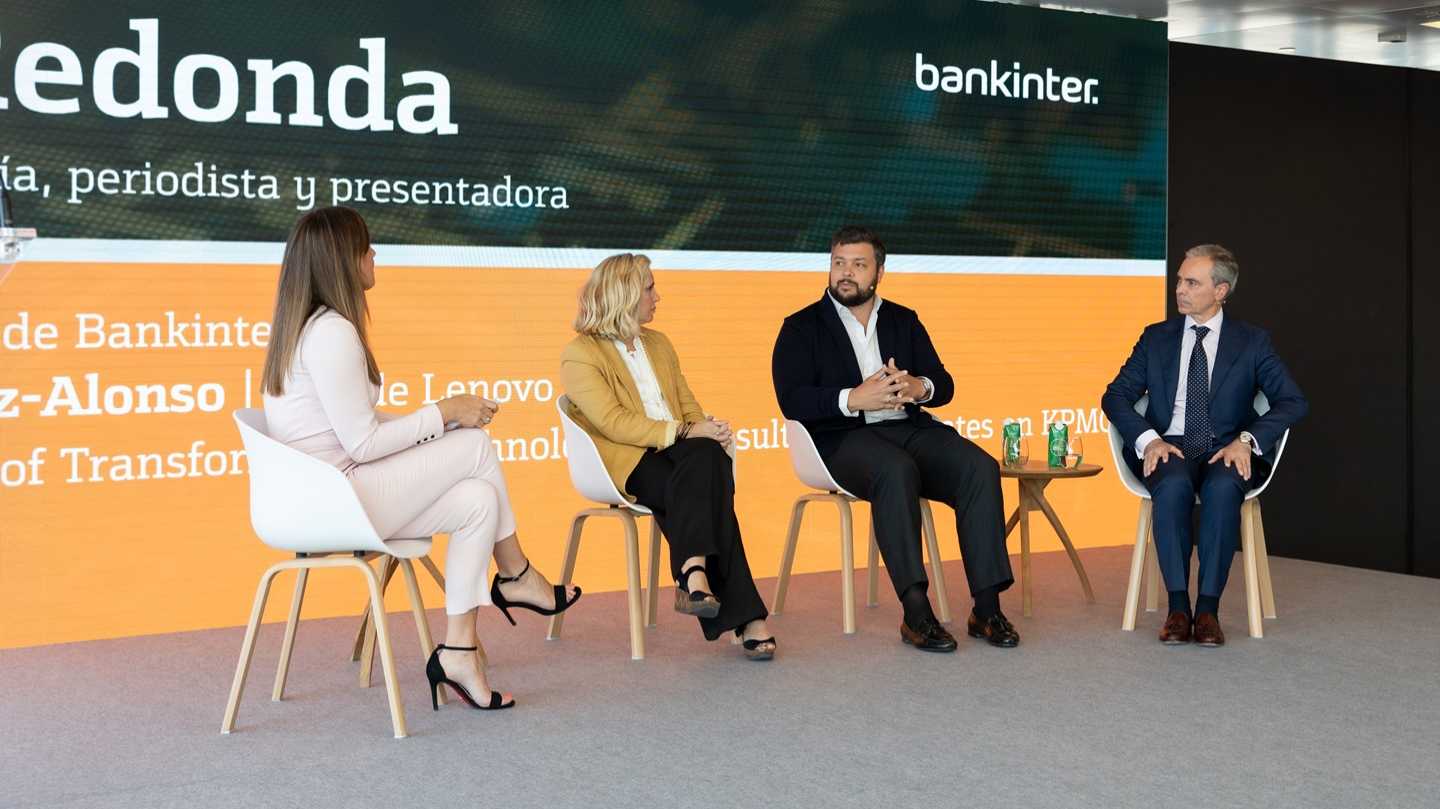
At a session organised by Bankinter's CFO Forum, data from the IV Frontline Report was presented and AI was extensively discussed, with testimonials from those already successfully applying it in their financial departments.
For Maite Cañas, head of Large-corporate Banking at Bankinter, the 2025 report highlights “the completely strategic role of CFOs in companies. In the past, CFOs were more focused on figures tracking and control, but now they have assumed a very significant role in companies. They are a key figure alongside the CEO, offering cross-functional leadership, vision, management in the face of uncertainty, and company transformation”.
Some headlines from this year's report, compiled from 200 surveys of CFOs of Spanish companies

- The main areas directly reporting to CFOs are Finance, Administration and Management Control. However, Compliance and Internal Audit are rising sharply, and areas such as Payroll Management and Human Resources are moving away from their leadership.
- The biggest concern for Spanish CFOs is the talent in their own department, both in terms of number and quality. Next comes financial and accounting legislation. There is growing concern about the area's technological resources and about non-performing loans.
- CFOs believe that what defines them, above all, is their strategic role, as confirmed by 76% of respondents, compared to 62% three years ago. Only 10% see themselves as a technical expert.
- The focus is on treasury management, followed closely by the digital transformation of the financial area.
- Only 4% of CFOs surveyed acknowledge that their company is at an advanced stage of AI development, compared to 87% who have just started and 9% who are in an intermediate state.
- AI is being applied with greater speed in cybersecurity, in Supply Chain Finance programs (with concrete benefits in inventory management and payments and cash flow) and in strategic planning (thanks to Generative AI).
Step by step: do not put too much strain on IT or Finance
During the Frontline Report's presentation, an idea was repeated: the need to move forward little by little in organisations and identify which use cases can be most applicable and have the greatest return. The speakers warned to be very careful about introducing AI into everything as an end in itself, or overburdening the technological areas.
Part one: talent and naturalness
“The first focus should be on prioritising talent, with upskilling and reskilling actions so that people can identify processes that can be automated without depending on IT. This is another of the big problems faced by companies: the IT department is under too much strain. Due to digitalisation and now due to AI”, acknowledged Ramón Fernández-Alonso, chief financial officer at Lenovo.
Internal fear of AI can be mitigated not only with training but with an increasingly natural adoption of this technology through the platforms that introduce it into their systems. In other words, it enters the company like a Trojan horse through software providers.
“Manufacturers are striving to make these new technologies easier to use and adopt. We're going to see less complexity when it comes to interacting with and developing new AI features”, according to Belén Díaz, partner in charge of Transformation at KPMG, and that will have a positive effect on IT: “There will be less dependence on the Technology area”.
It's essential to rely on technology partners who, in the eyes of the CFO, guarantee a return on the investment. The KPMG expert welcomed the fact that CFOs are addressing the technological renewal of their ERPs, a software that is undergoing a revolution with AI: “Many ERP technologies are embedding AI as a structural part of their system”.
“The solutions handled by CFOs will naturally and in a less complex manner embed Generative AI.”
In other words, AI is being introduced into corporates naturally, not only with ERP systems but also in analytical and reporting systems and in niche treasury solutions, as the KPMG partner explained. “One of the big paradigm shifts is the ease of use of Generative AI and how we will find it embedded in all types of platforms.”
Part two: the raw material of AI
Data is the raw material of Artificial Intelligence. And if it is not quality data, if not structured or well-governed, AI will only amplify errors.
“Data is somewhat neglected. You must have a well-organised base to run at a much faster speed, but also much more safely”
“You have to make certain preparations. To be able to exploit AI, you must have structured data of sufficient quality”, pointed out Belén Díaz of KPMG.
For Jacobo Díaz, CFO of Bankinter, “the risk is that AI does things that are not right”, a problem that is multiplied by the fact that data is very sensitive information in certain organisations. For example, at Bankinter there are one hundred AI models in operation, and the key is that “the data is centralised, well governed, with a high level of quality and that its use aligns with the regulatory framework”.
“Data is somewhat neglected. You need to have a well-organised base to run at a much faster speed, but also much more safely”, stressed the Bankinter CFO.
For Ramón Fernández-Alonso, in addition to data quality, there is a need for ethical standards to ensure that data and AI do not produce biases, that “automation processes with integrated AI are auditable, and that there is human supervision”.
Part three: AI culture
We must “focus on projects that generate value”, according to Ramón Fernández-Alonso: “AI is all the rage, but it can't be implemented everywhere at once. There must be a focus and a strategic approach when implementing it. You have to go little by little, start with smaller processes and then scale up”, Lenovo's CFO stressed.
In the financial area, where it is most easily integrated and provides the most value, “it must start in processes where there is constant repetition: bank consolidation, accounting closures or reporting”, explained Ramón Fernández-Alonso.
We are talking about processes, said Lenovo's CFO, “where there is high consumption of resources, with very low added value, and more prone to error. That's where I would put automation”.
In the words of Jacobo Díaz, it is about creating an “AI culture” in organisations, where the finance department is called to lead this transformation throughout the organisation.
For Bankinter's CFO, we should not only talk about how to integrate AI into the financial area, but also about how we transform the entire organisation.

“What really matters in my case is to govern the transformation of the bank as a whole, not just finance. It's all about good training, good knowledge of the tools and good data”, he stressed.
How to detect this willingness to internalise AI culture? Being a particularly restless entity that adapts perfectly to any environment is a good starting point. As Jacobo Díaz summarised, sometimes the answer lies in the organisation's values, as in the case of Bankinter, where the A is for agility, the E is for enthusiasm, the I is for integrity and the O is for originality.
CFO: technologist or strategist?
A debate opened by this new edition of Bankinter's CFO Frontline Report is whether the financial area needs a more technological strategic profile. And the guests at the CFO Forum agreed that you don't have to be a technologist.
“My background isn't in technology, explained Jacobo Díaz of Bankinter. The role of a CFO is to help a chief executive officer and a board of directors to make decisions. It is very important not to lose that vision. Transformation management cannot be perceived as merely technical. Of course, we must embrace technology, but technology is a means to achieve our goals, not an end.
“Of course, we must embrace technology. But technology is a means to achieve our goals, not an end.”
“You have to be a friend of technology, but I don't think a CFO has to be a technologist, but rather a friend of technology, knowing what it can do, having resources to consider how to leverage use cases, but not being the ones who build technological solutions”, added the chief financial officer of Bankinter.
Ramón Fernández-Alonso, from Lenovo, completely agreed: “The CFO doesn't have to be a technologist. Our mindset is strategic: we have to be facilitators of technology, but at the service of the business. We must be able to talk about AI, data architecture, but AI that serves the business. And to guarantee that these investments have a return.”
KMPG's Belén Díaz believes CFOs must lead this transformation within the company, thus driving their role. “I see few CFOs who have made their own technological transformation and are prepared to support the business in the launch of new products and services or new relationship models with customers and suppliers”, said the KPMG partner.
A bit of science fiction: what will the financial area be like in 2030?
During the discussion, a question was raised that challenges us all: How do we imagine the finance department in 5 years, once AI is likely integrated into our lives and our company?
“I see AI in 5 years as a co-pilot to the CFO”
“I see a maximum reduction of repetitive processes and AI as a co-pilot to the CFO. I don't think the Finance area will be reduced; instead, new positions and opportunities will open up. It will be different and much more strategic. There will be much more time and more information available to do more critical and strategic work”, Lenovo's CFO responded.
This more strategic role will define the CFO of 2030, according to Jacobo Díaz. “I don't see AI as a threat, but as a tremendous opportunity to be better. I encourage CFOs to assume the necessary importance to be protagonists of the company's transformation, where knowledge of the financial area can help enormously”, said Bankinter's chief financial officer.
For Belén Díaz Sánchez (KPMG), there will be an adjustment in the number of people assigned to the financial area because many tasks without added value will have disappeared.
“There will be fewer people in the Finance area, but with a greater capacity to provide vision, direction, and anticipation.”
“I would envisage a Finance area without so many hours spent on closing processes, or generating reports. The everyday use of AI will lead to a smaller team, but with a much greater capacity to provide vision, direction, and anticipate risks. They will interact more naturally with AI through agents that are embedded in the platforms managed by the financial area”, predicted the KPMG expert.
In 2030, we will be on our ninth CFO Frontline Report. How do you think this profile will evolve? Should we ask the AI?

