The world has experienced extraordinary changes in the past half century. From a geopolitical point of view, we have evolved from a world of two confronted blocks to a geopolitical multipolar reality. Spain has gone from being a country with traits of an emerging economy to a state aligned with the rest of developed societies. During that period, the Spanish banking system experienced an extraordinary growth. The current volume of bank assets is 370 times the volume that it was 50 years ago.
The half century elapsed between 1965 and 2015 has been marked by an intense process of internationalisation of the economy, as can be inferred from the statistics for trade and investment flow. Two aspects drove this process:
This liberalisation involved further economic growth and, in combination with other factors, such as the technological revolution, the establishment of institutions and the progress of democratic systems around the world, it has provided a significant improvement of the indicators of social welfare. A clearest example of this progress is the considerable rise in life expectancy, which increased from 56 to 71 years of age during that period.
From a political point of view, in 1965 the world was polarised between Western capitalism and the communist countries, although cracks started to appear in both blocks. The Vietnam War, which broke out in 1965, caused a strong protest from the USA. Simultaneously, cultural and popular protest movements started to emerge in the Western world (the hippy movement, the May 1968 events in France and rock and roll). Meanwhile, strong political dissidence appeared in the Eastern European countries that would culminate in the repression of The Prague Spring.
In 2015, the geopolitical reality is much more fragmented. The fall of the Berlin Wall in 1989, the growing economic and political influence of the developing countries (especially, China) and the instability in the Middle East have created a multipolar scenario that is difficult to decipher and that involves very complex conflicting interests.
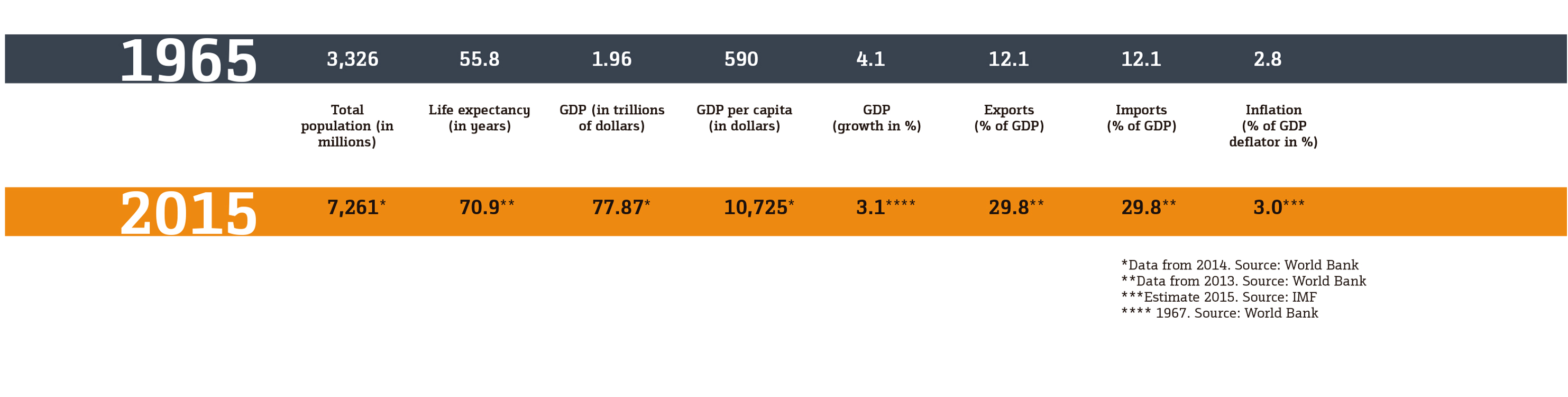

In the past fifty years, Spanish society has experienced a remarkable journey. In this half century, Spain has evolved from being a semi-autocratic country with traits of an emerging economy (strong economic growth, high inflation, limited openness) to a country perfectly aligned with the rest of the developed Western societies in the main socioeconomic indicators.
The most noteworthy aspect of this evolution was the spectacular growth of the GDP per capita (quotient between the total resources produced and the number of inhabitants), which measured in dollars has grown fortyfold. Spain has evolved from a relatively average wealthy economy (in 1965 it was far off the GDP per capita of European countries, the United States, Argentina, Australia or Canada and on the same level as Greece, Chile or Uruguay) to one of the top economies, tripling the global average.
From an economic point of view, 1965 was a pivotal point of a period of great expansion. After initiating the Stabilisation and Development plans, several circumstances occurred at a same point in time that greatly stimulated the economy: the improvement of the population's level of education, the promotion of industrial development, currency remittances from abroad, a boost in tourism and the opening to international trade. As a result, Spain was able to consolidate a period of expansion that lasted a decade and a half (between 1961 and 1974 the average annual growth of the Spanish GDP was 7.3%) and that would conclude with the outbreak of the first international oil crisis.
In terms of political organisation, 1965 is considered the beginning of a stage of a certain level of liberalisation within the Franco regime, embodied by the reform measures implemented by the Minister of Information and Tourism, Manuel Fraga. The most tangible expression of this reform was the approval, in that same year, of the controversial Press Law, which abolished censorship.
Fifty years later, democracy is consolidated, Spain is another member of the European institutions and, with the unavoidable upheavals of a lively society, the political system equips itself to face a new and more pluralistic and participatory stage.
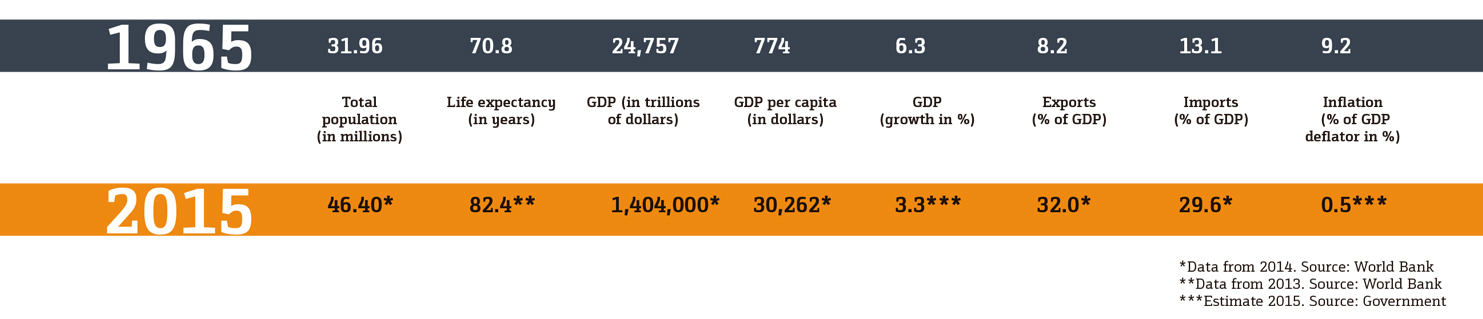
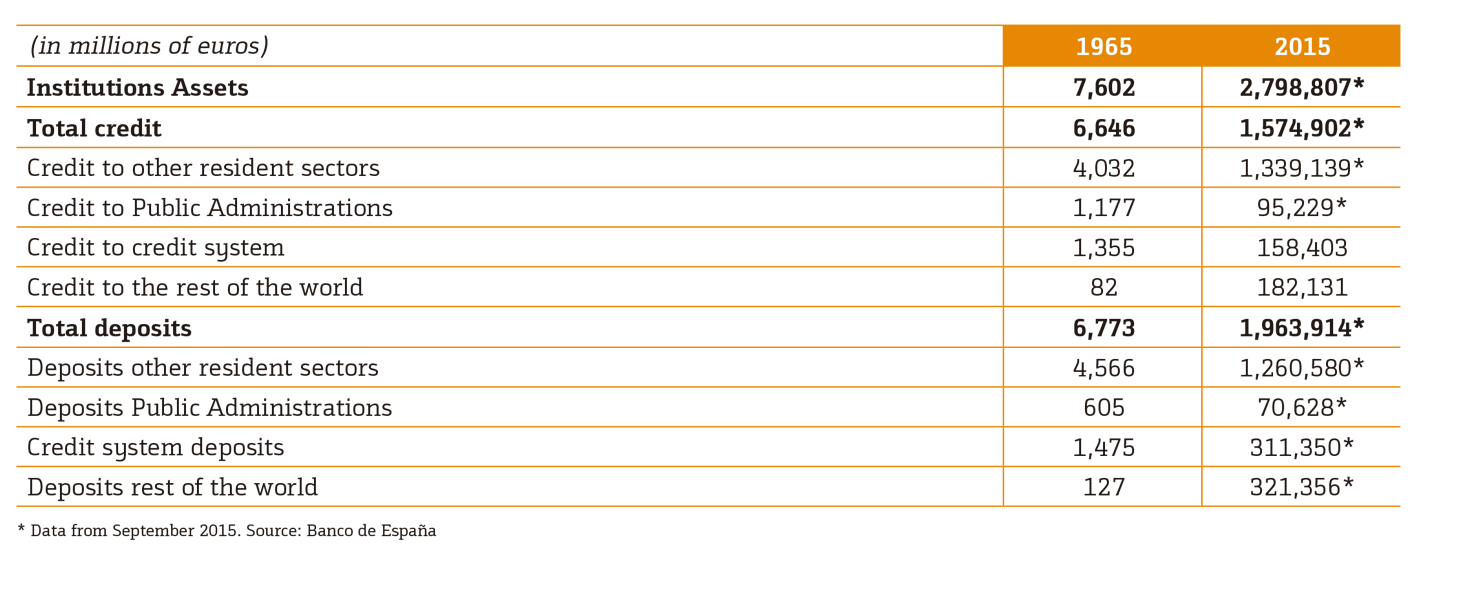
When comparing the main variables of the Spanish banking system of 1965 and those of 2015, differences are revealed that go well beyond what can be considered a reasonable evolution in such a short period. The current volume of assets of the credit institutions multiplies by 370 the volume that existed 50 years ago; regarding credit, it is 240 times more; and in terms of deposits, 290 times. As a contrast, the GDP only multiplied itself by 60. This evolution is a reflection, on the one hand, of the flourishing state of Spanish banking in 1965, and, on the other, the spectacular development that it has experienced since.
This enormous quantitative and qualitative leap of the financial system started to hatch precisely in the sixties. Following the reorganisation carried out by the Stabilisation Plan, the Spanish economy took off and required more resources to support its expansion. The financing needs were covered, among other reasons, thanks to the rise in bank deposits, which between 1965 and 1975 rocketed reaching a historical record of 90% of the GDP. Similarly, the Banco de España, on some occasions, would support liquidity via monetary measures.
The entry into force in 1962 of a decree-law that permitted the establishment of commercial and industrial banks also provided new lines of long-term financing for companies. Up to that moment, funding mechanisms were mainly short-term.
Bankinter, which was initially established as Banco Intercontinental Español, emerged precisely under the protection of this new law. This law, although restrictive in some aspects (new banks could not have more than three branches), had a very positive impact on relaunching the funding of industrial activities.
All this resulted in a rapid increase of assets of the domestic banking system, which in four years doubled in volume. In 1965 only, the total credit and securities portfolio grew by 25%. The highest rate of increase of new funding corresponded to industrial banking, which had an ample margin for growth as a result of its recent creation. In addition, funding from official credit institutions also grew, which confirmed the support of the authorities in the accelerated expansion of the Spanish economy.
This expansion of the Spanish banking sector continued uninterruptedly for the following 47 years at varying rates, in synchronicity with the economic situation. This upward path came to a halt in 2013 as a result of the financial crisis. In that financial year, the volume of assets of the banking sector dropped by 11.6%, from 3,422 and 3,025 trillion euros. This contraction continued through the years 2014 and 2015. Between 2008, year of beginning of the crisis, and September 2015, assets fell by 13.2%, largely caused by a credit drop of 25.7%.


1969. View of the Bankinter Building, Headquarters at Paseo de la Castellana of Madrid.
When comparing the main variables of the Spanish banking system of 1965 and those of 2015, differences are revealed that go well beyond what can be considered a reasonable evolution in such a short period. The current volume of assets of the credit institutions multiplies by 370 the volume that existed 50 years ago; regarding credit, it is 240 times more; and in terms of deposits, 290 times. As a contrast, the GDP only multiplied itself by 60. This evolution is a reflection, on the one hand, of the flourishing state of Spanish banking in 1965, and, on the other, the spectacular development that it has experienced since.
This enormous quantitative and qualitative leap of the financial system started to hatch precisely in the sixties. Following the reorganisation carried out by the Stabilisation Plan, the Spanish economy took off and required more resources to support its expansion. The financing needs were covered, among other reasons, thanks to the rise in bank deposits, which between 1965 and 1975 rocketed reaching a historical record of 90% of the GDP. Similarly, the Banco de España, on some occasions, would support liquidity via monetary measures.
The entry into force in 1962 of a decree-law that permitted the establishment of commercial and industrial banks also provided new lines of long-term financing for companies. Up to that moment, funding mechanisms were mainly short-term.
Bankinter, which was initially established as Banco Intercontinental Español, emerged precisely under the protection of this new law. This law, although restrictive in some aspects (new banks could not have more than three branches), had a very positive impact on relaunching the funding of industrial activities.
All this resulted in a rapid increase of assets of the domestic banking system, which in four years doubled in volume. In 1965 only, the total credit and securities portfolio grew by 25%. The highest rate of increase of new funding corresponded to industrial banking, which had an ample margin for growth as a result of its recent creation. In addition, funding from official credit institutions also grew, which confirmed the support of the authorities in the accelerated expansion of the Spanish economy.
This expansion of the Spanish banking sector continued uninterruptedly for the following 47 years at varying rates, in synchronicity with the economic situation. This upward path came to a halt in 2013 as a result of the financial crisis. In that financial year, the volume of assets of the banking sector dropped by 11.6%, from 3,422 and 3,025 trillion euros. This contraction continued through the years 2014 and 2015. Between 2008, year of beginning of the crisis, and September 2015, assets fell by 13.2%, largely caused by a credit drop of 25.7%.

Madrid, 1971. Executives and employees of the bank performing different tasks during first few years of the financial institution.